

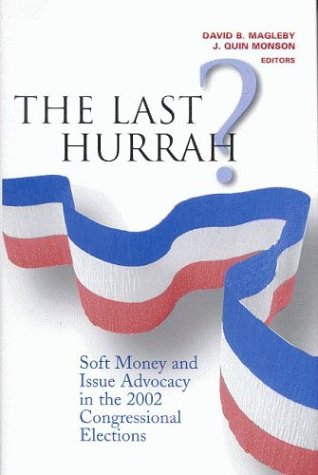
The Last Hurrah Soft Money and Issue Advocacy in the 2002 Congressional Elections 1st edition by David Magleby, Quin Monson 0815796404 9780815796404
Original price was: $50.00.$35.00Current price is: $35.00.
The Last Hurrah Soft Money and Issue Advocacy in the 2002 Congressional Elections 1st Edition by David B. Magleby, J. Quin Monson – Ebook PDF Instant Download/Delivery: 0815796404, 9780815796404
Full download The Last Hurrah Soft Money and Issue Advocacy in the 2002 Congressional Elections 1st Edition after payment
Product details:
ISBN 10: 0815796404
ISBN 13: 9780815796404
Author: David B. Magleby, J. Quin Monson
The 2002 midterm elections were noteworthy U.S. congressional campaigns for many reasons. They marked the last national contests before implementation of the Bipartisan Campaign Reform Act (BCRA) and thus were expected by many to be the “”last hurrah”” for soft money. These midterm campaigns provided a window on the activity of parties, interest groups, and political consultants on the eve of BCRA, as they prepared to enter a new era of American elections. The results of Campaign 2002 were remarkable. As the party in power, the Republicans defied history by gaining seats in both houses of Congress, giving them a majority in the Senate. To some degree this resulted from the GOP’s new emphasis on “”ground war”” voter mobilization. Another key was the unusually aggressive support of the sitting president, who leveraged his popularity to advance his party’s candidates for Congress. Th e Last Hurrah? analyzes the role of soft money and issue advocacy in the 2002 battle for Congress. Having been granted access to a number of campaign operations across a broad array of groups, David Magleby, Quin Monson, and their colleagues monitored and documented a number of competitive races, including the key South Dakota and Missouri Senate contests. Each case study breaks down the campaign communication in a particular race, including devices such as advertising, get-out-the-vote drives, “”soft money”” expenditures, and the increasingly influential role of the national parties on local races. They also discuss the overall trends of the midterm election of 2002, paying particular attention to the impact of President Bush and his political operation in candidate recruitment, fundraising, and campaign visits. Magleby and Monson consider an important question typically overlooked. How do voters caught in the middle of a hotly contested race deal withand react toa barrage of television and radio ads, direct mail, unsolicited phone calls, and other campaign communications? T
The Last Hurrah Soft Money and Issue Advocacy in the 2002 Congressional Elections 1st Table of contents:
Chapter One. The Importance of Outside Money in the 2002 Congressional Elections
Chapter Two. Party Money in the 2002 Congressional Elections
Chapter Three. Interest-Group Electioneering in the 2002 Congressional Elections
Chapter Four. Get On TeleVision vs. Get On The Van: GOTV and the Ground War in 2002
Chapter Five. From Intensity to Tragedy: The Minnesota U.S. Senate Race
Chapter Six. Battle for the Bases: The Missouri U.S. Senate Race
Chapter Seven. The More You Spend, the Less They Listen: The South Dakota U.S. Senate Race
Chapter Eight. Strings Attached: Outside Money in Colorado’s Seventh District
Chapter Nine. Incumbent vs Incumbent in Connecticut’s Fifth District
Chapter Ten. When Incumbents Clash, Fundamentals Matter: Pensylvania Seventeen
Chapter Eleven. When Redistricting Means Never Having to Say You’re Sorry: Utah’s Second District
Chapter Twelve. The Consequences of Noncandidate Spending, with a Look to the Future
People also search for The Last Hurrah Soft Money and Issue Advocacy in the 2002 Congressional Elections 1st:
what is soft money in politics
issue advocacy explained
campaign finance reform us
soft money vs hard money
role of interest groups in elections
Tags: The Last Hurrah, Soft Money, Issue Advocacy, Congressional Elections, David Magleby, Quin Monson