

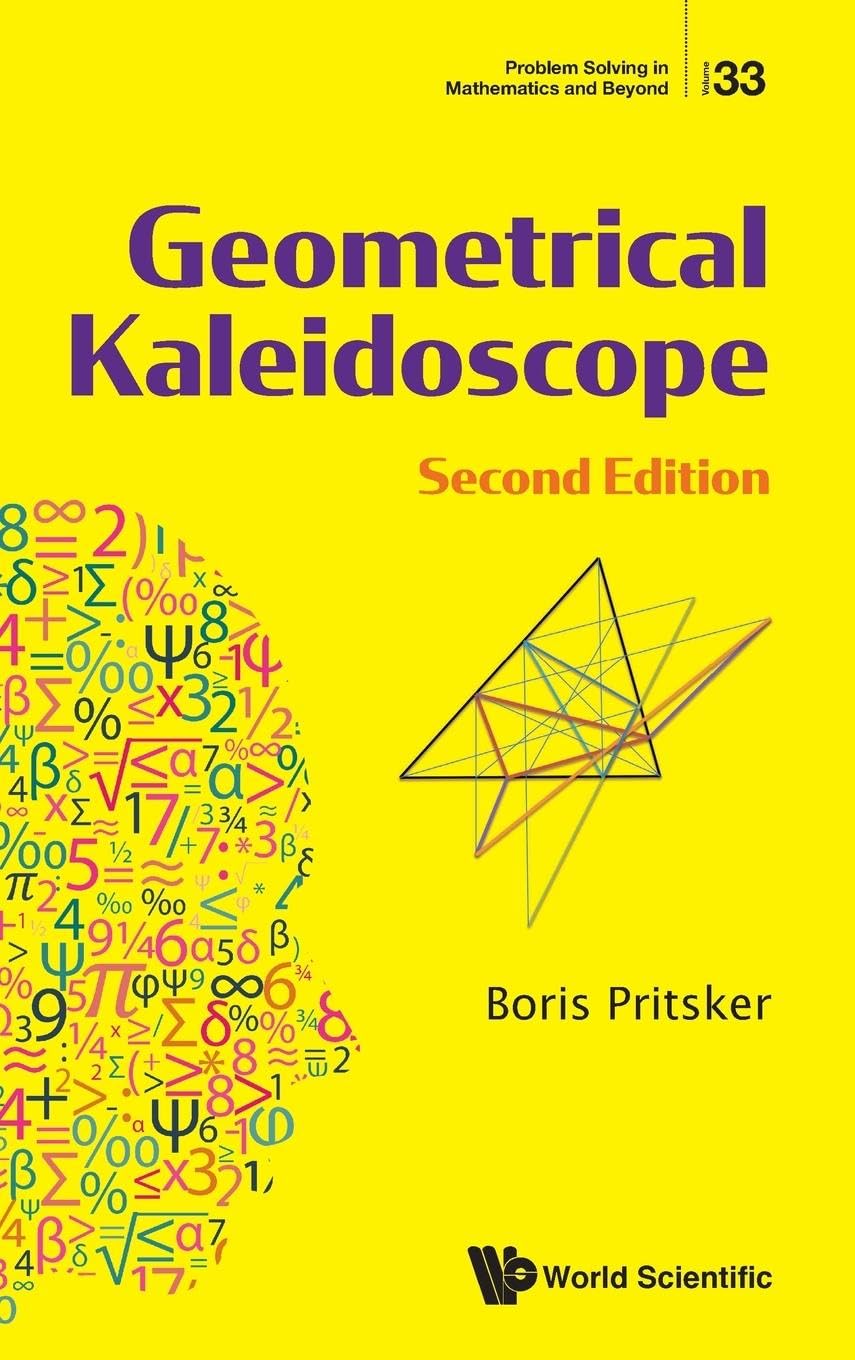
Geometrical Kaleidoscope 2nd Edition by Boris Pritsker ISBN 9811285276 9789811285271
Original price was: $50.00.$35.00Current price is: $35.00.
Geometrical Kaleidoscope 2nd Edition by Boris Pritsker – Ebook PDF Instant Download/Delivery: 9811285276, 9789811285271
Full download Geometrical Kaleidoscope 2nd Edition after payment
Product details:
ISBN 10: 9811285276
ISBN 13: 9789811285271
Author: Boris Pritsker
The goal of the book is to provide insight into many enjoyable and fascinating aspects of geometry, and to reveal interesting geometrical properties. The emphasis is on the practical applications of theory in the problem-solving process. The chapters cover a myriad of topics among which are the classic theorems and formulas such as Archimedes’ Law of the Lever, the Pythagorean Theorem, Heron’s formula, Brahmagupta’s formula, Appollonius’s Theorem, Euler’s line properties, the Nine-Point Circle, Fagnano’s Problem, the Steiner-Lehmus Theorem, Napoleon’s Theorem, Ceva’s Theorem, Menelaus’s Theorem, Pompeiu’s Theorem, and Morley’s Miracle. The book focuses on geometric thinking ― what it means, how to develop it, and how to recognize it. “Geometrical Kaleidoscope” consists of a kaleidoscope of topics that seem to not be related at first glance. However, that perception disappears as you go from chapter to chapter and explore the multitude of surprising relationships, unexpected connections, and links. Readers solving a chain of problems will learn from them general techniques, rather than isolated instances of the application of a technique. In spite of the many problems’ challenging character, their solutions require no more than a basic knowledge covered in a high school geometry curriculum. There are plenty of problems for readers to work out for themselves (solutions are provided at the end of the book).
Geometrical Kaleidoscope 2nd Table of contents:
Part I: Foundations of Geometry
-
Historical Perspectives on Geometry
-
Ancient Geometry
-
Renaissance and Modern Developments
-
-
Fundamental Geometrical Concepts
-
Points, Lines, and Planes
-
Angles, Circles, and Polygons
-
-
Symmetry and Transformation
-
Reflections, Rotations, and Translations
-
Scaling and Shearing
-
Part II: Patterns and Tessellations
4. Repeating Patterns in Nature and Art
-
Fractals and Spirals
-
Crystals and Natural Symmetry
-
Tessellations and Tilings
-
Regular, Semi-Regular, and Aperiodic Tilings
-
Mathematical Principles Behind Tessellations
-
-
Kaleidoscopic Designs
-
Mirrors and Rotational Symmetry
-
Creating Visual Complexity
-
Part III: Advanced Geometrical Concepts
7. Polyhedra and 3D Geometry
-
Platonic, Archimedean, and Catalan Solids
-
Euler’s Formula and Beyond
-
Non-Euclidean Geometries
-
Spherical and Hyperbolic Geometry
-
Applications in Art and Science
-
-
Computational Geometry
-
Algorithms for Shapes and Patterns
-
Visual Simulations
-
Part IV: Geometry in Motion and Art
10. Dynamic Symmetry
– Transformations Over Time
– Animating Geometrical Patterns
11. Geometry and Modern Art
– From Islamic Art to Contemporary Design
– Interactive and Digital Kaleidoscopes
People also search for Geometrical Kaleidoscope 2nd:
the computational nature of language learning and evolution
what is the nature of language
what is computational linguistics
nature of language examples
5 nature of language
Tags: Boris Pritsker, Geometrical, Kaleidoscope