

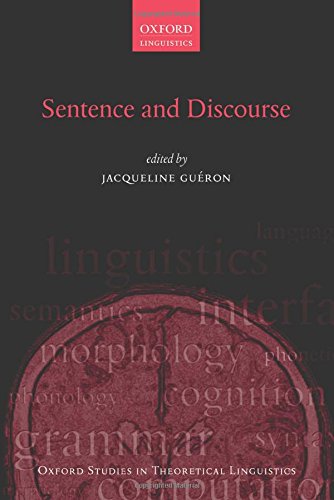
Sentence and discourse 1st Edition by Jacqueline Gueron ISBN 0198739427 9780198739425

Original price was: $50.00.$35.00Current price is: $35.00.
Sentence and discourse 1st Edition by Jacqueline Gueron – Ebook PDF Instant Download/Delivery: 0198739427, 9780198739425
Full download Sentence and discourse 1st Edition after payment
Product details:
ISBN 10: 0198739427
ISBN 13: 9780198739425
Author: Jacqueline Gueron
Sentence and discourse 1st Table of contents:
1: Introduction
1.1 Presentation of the volume
1.1.1 Sentence Grammar and Discourse Relations
1.1.2 The speaker and the subject
1.1.3 Sentence, discourse, and time
1.2 Contents of the volume
1.2.1 From sentence grammar to discourse
1.2.2 From discourse to sentence grammar
Part I: From Sentence to Discourse
2: On the temporal orientation of intensional subjunctives in Spanish
2.1 Intensional versus polarity subjunctives
2.2 The temporal orientation of matrix verbs selecting intensional subjunctives
2.3 The semantics of volitionals
2.3.1 Volitionals as attitudes of preference
2.3.2 Volitionals as dispositions to act
2.4 Volitionals, evaluative-factives, and counterfactual morphology
2.5 Conclusion and outlook
Postscriptum
Acknowledgment
3: Russian aspect in finite and non-finite modes: from syntax to information structure
3.1 Traditional accounts of the aspectual opposition
3.1.1 Situation aspect and viewpoint aspect
3.1.2 Conventions of use or “particular senses” (Bondarko 1971)
3.2 VA is neutral, SA is grammaticized
3.2.1 Prefixes are quantity markers
3.2.2 What is telicity?
3.2.3 SA is grammaticized, VA is neutral
3.3 From syntax to discourse: the case of infinitives
3.3.1 Corpus results
3.3.2 Commentary
3.3.3 Syntactic structure and discourse interaction
3.4 Conclusion
4: {A/a}spect/discourse interactions
4.1 The imparfait/passé simple (IMPF/PS) tenses and (external) temporal aspect
4.1.1 The role of the opposition IMPF/PS in the identification of modes of discourse
4.1.2 The PS/IMPF opposition
4.2 Modes of action and the representation of Aktionsart
4.2.1 The role of Aktionsart in the grammar
4.2.2 The expression of telicity in Romance and Germanic languages
4.3 Examination of a corpus
4.4 Towards a solution
4.4.1 Discourse referents
4.4.2 Articled definite N.pl versus unarticled bare indefinite Ø N.pl
4.4.3 The definite article, a choice by default?
4.4.4 The definite article, a conditioned choice by default
4.5 Conclusion
5: Time talk in narrative discourse: evidence from child and adult language acquisition
5.1 Introduction
5.1.1 Temporality across languages
5.1.2 Temporality in child language
5.2 Temporal-aspectual markings in children’s narratives
5.2.1 Method
5.2.1.1 Participants
5.2.1.2 Materials
5.2.1.3 Procedure
5.2.1.4 Coding and analyses
5.2.2 Results
5.2.2.1 Verbal morphology and temporal anchoring: English, French, German
5.2.2.2 Aspect markers in Chinese
5.2.2.3 Other temporal-aspectual markings: connectives
5.2.2.4 Relation between predicate types and temporal-aspectual markers
5.2.2.5 Discourse contexts of temporal-aspectual shifts
5.2.3 Summary of child data
5.3 Comparative data from adults learning a second language
5.3.1 Method
5.3.2 Synthesis of results
5.3.2.1 Temporal-aspectual devices used: verbal morphology and other devices
5.3.2.2 Relation between verbal morphology and predicate types
5.4 Discussion
5.4.1 Summary of results
5.4.2 General cognitive determinants
5.4.3 Language-specific determinants
5.4.4 Levels of linguistic organization: functional determinants
5.5 Concluding remarks
Appendix: Picture sequences used as stimuli
6: On the syntax of modality and the Actuality Entailment
6.1 Introduction: the Actuality Entailment
6.2 Arguments against the syntactic hypothesis
6.2.1 The data are not solid
6.2.2 The AE is not limited to modal auxiliaries in English
6.2.3 No need for two modal positions
6.2.4 AE without modals
6.2.4.1 Middle structures
6.2.4.2 It took x time to …
6.2.4.3 (X suffices to acquire Y)
6.2.4.4 Verbs of deprivation
6.2.4.5 menacer in French/threaten in English (also promettre/promise)
6.2.5 The Aspect Projection
6.2.6 Agentivity
6.3 Towards an alternative hypothesis
6.3.1 Tense and Aspect as formal features
6.3.2 Operators versus verbs
6.3.3 Verbal scenarios
6.3.4 The agentive paradox
6.3.5 Aspect
6.3.6 Modality and “discours”
6.4 Conclusion
Part II: From Discourse to Sentence
7: Implicatures and grammar
7.1 Introduction
7.2 Preliminaries
7.3 Moving to strategic conversation
7.4 The model
7.5 Back to implicatures
8: Perfect puzzles in discourse
8.1 Introduction
8.2 Pancheva and von Stechow’s explanation
8.3 Some assumptions about aspect in English versus German and French
8.3.1 The second puzzle: perfect with the past tense
8.4 Moving to discourse
8.4.1 Perfects with discourse structure
8.5 Conclusions
9: The passé composé in Old French and Modern French: evolution or revolution?
9.1 Introduction
9.2 Assessing the late perfectivization hypothesis: basic tenets and evidence
9.2.1 The late perfectivization hypothesis: the OF PC as an intermediate form between a resultative
9.2.2 Arguments for the late perfectivization hypothesis
9.2.2.1 Morphosyntactic evidence for the persistence of proto-perfect features in the PC
9.2.2.2 Analogy with narrative uses of the passé antérieur (PA)
9.2.2.3 The PC and aspectuo-temporal modifiers: convergences with the present
9.2.2.4 Completing the late perfectivization picture: how did the OF PC lose its proto perfect seman
9.3 Re-assessing the perfectivization of the PC in OF: new data and analysis
9.3.1 The present component of the PC in narrative uses: imperfective or perfective viewpoint?
9.3.2 SOE uses of the OF PC: weak (inchoative) or strong perfective uses?
9.3.3 Why the standard late perfectivization hypothesis is not fully satisfying
9.4 Combining an innovative pragmatics with a conservative semantics to account for the perfective u
9.4.1 Outlining a novel, composite account
9.4.2 The dynamic historical perspective issue: agentivity versus SOE contexts
9.5 Conclusion: an evolution rather than a revolution
Appendix I: Corpus analysis
Appendix II: Formal implementation
10: Polyphonic utterances: alternation of present and past in reported speech and thoughts in Russia
10.1 Aims
10.2 Different approaches to pronouns and tenses in ID and FID
10.3 Tenses in French and Russian reported speech
10.3.1 The French SOT
10.3.2 The Russian non-SOT
10.4 De re, de dicto, and de se readings of pronouns
10.5 Tenses in ID under saying predicates
10.5.1 De re reading of tenses
10.5.2 Imparfait versus present in French
10.5.3 De dicto and de re present in Russian
10.5.4 Overlapping IMPERF-PST under saying predicates
10.5.5 Short conclusion
10.6 Present and past under cognitive factive predicates
10.7 From ID to (quasi-)FID
10.7.1 Colon and “primacy of direct discourse”
10.7.2 Bivocal (quasi-)FID
10.8 Conclusion
11: Free Indirect Discourse and the syntax of the left periphery
11.1 Introduction
11.2 Free indirect discourse: the properties
11.3 The syntax of the speaker’s temporal coordinate
11.4 FID and the C-speaker projection
11.4.1 Temporal locutions and the role of the speaker
11.4.2 Tenses
11.4.3 Some generalizations
11.5 Towards a syntax of free indirect discourse
11.5.1 The syntax of tense in FID sentences
11.5.2 On the syntax of the “introducing predicate”
11.6 Conclusions
12: Subjectivity and Free Indirect Discourse
12.1 Subjectivity
12.2 Literature
12.2.1 The power of literature
12.2.2 Unspeakable sentences
12.2.3 Iconic effects: the interaction of the ordinary and the literary grammars
12.2.3.1
12.2.3.2
12.2.3.3
12.2.4 What the literary text lacks
12.3 Subject of consciousness versus “point of view”
12.4 Free Indirect Discourse
12.4.1 The properties of Free Indirect Discourse
12.4.2 The grammar of Free Indirect Discourse
12.4.3 The syntactic structures of direct speech, indirect speech, and free indirect speech (FID/RST)
12.4.3.3 Free Indirect Discourse/represented speech and thought
12.4.4 The grammatical status of the fid text
People also search for Sentence and discourse 1st:
sentence and discourse 1st
9 sentences
8 sentence structure
w sentences speech therapy
word sentence and discourse level
Tags: Jacqueline Gueron, Sentence, discourse