

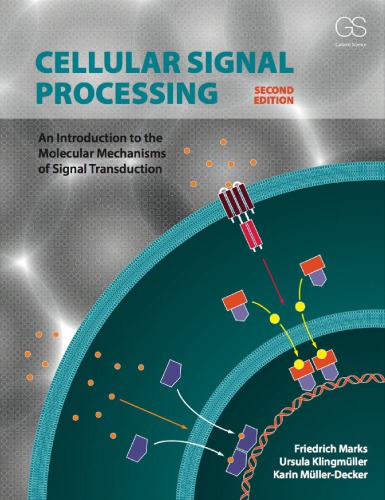
Cellular Signal Processing An Introduction to the Molecular Mechanisms of Signal Transduction 1st Edition by Friedrich Marks, Ursula Klingmuller, Karin Muller Decker ISBN 0815345348 9780815345343

Original price was: $50.00.$35.00Current price is: $35.00.
Cellular Signal Processing An Introduction to the Molecular Mechanisms of Signal Transduction 1st Edition by Friedrich Marks, Ursula Klingmuller, Karin Muller Decker – Ebook PDF Instant Download/Delivery: 0815345348, 9780815345343
Full download Cellular Signal Processing An Introduction to the Molecular Mechanisms of Signal Transduction 1st Edition after payment
Product details:
ISBN 10: 0815345348
ISBN 13: 9780815345343
Author: Friedrich Marks, Ursula Klingmuller, Karin Muller Decker
Cellular Signal Processing An Introduction to the Molecular Mechanisms of Signal Transduction 1st Table of contents:
Chapter 1: The “Brain of the Cell”: Data Processing by Protein Networks
1.1 Metaphors and reductionism: temptations and limitations
1.2 Information and signals
1.3 Proteins are binary switches
1.4 Signal-transducing proteins are “nanoneurons”
1.5 Proteins form logical gates and “neural networks”
1.6 Privacy versus publicity
1.7 Cross talking and network formation
1.8 Interaction domains: how the network is plugged together
1.9 Generation of signaling patterns
Chapter 2: Supplying the Network with Energy: Basic Biochemistry of Signal Transduction
2.1 No order without work
2.2 Redox and nitrosylation switches: a balance on a narrow ridge
2.3 Switches operated by enzymes that hydrolyze energy-rich compounds
2.4 GTPase or G-protein switch
2.5 ATPase switches
2.6 Protein phosphorylation
2.7 Protein acetylation and methylation: tools of gene regulation and more
2.8 Protein ubiquitylation: more than a signal of protein degradation
2.9 Mono- and poly(ADP-ribosylation)
2.10 Ion channel switches: how to make use of electrical charge
2.11 Proteolysis switch: protein degradation provides messenger molecules and energy
2.12 Receptors: how energy-supplying reactions are combined with signal transduction
2.13 Brief summary of experimental standard methods for investigation of signaling pathways
2.14 Model organisms for investigation of cellular signal processing
Chapter 3: Evolution of Cellular Data Processing
3.1 Evolution of biological signal processing
3.2 The RNA world
3.3 Signal-controlled membrane transport: the ancient way to communicate
3.4 Sensor-dependent signal processing: two-component systems
3.5 From vagabonds to societies: “bacterial hormones”
3.6 From bacteria to humans: evolution of signaling mechanisms
Chapter 4: Basic Equipment: G-Proteins, Second Messengers, and Protein Kinases
4.1 Life is stress
4.2 Discovery of intracellular signal transduction
4.3 Trimeric G-proteins: coupling of receptors with the protein network
4.4 Downstream of G-proteins: enzymes producing second messengers
4.5 Guanylate cyclases are not controlled by trimeric G-proteins
4.6 The next level: protein kinases as sensors of second messengers
Chapter 5: Signal Transduction by Receptors with Seven Transmembrane Domains
5.1 An evolutionary model of success
5.2 G-protein-coupled receptors: structure and mode of operation
5.3 Adrenergic receptors: sensors of stress and sympathetic signals
5.4 Muscarinic acetylcholine receptors are sensors of parasympathetic signals
5.5 Stress and the heart: the competition between sympathetic and parasympathetic signals
5.6 Protease-activated receptors are major players in blood clotting and inflammation
5.7 Adaptation of G-protein-controlled signaling: a matter of feedback
5.8 Arrestins are multifunctional adaptors for signaling cross talk
5.9 Heptahelical receptors in hedgehog and Wnt signaling pathways
5.10 Other G-protein-independent heptahelical receptors: lessons from slime molds and Homer
Chapter 6: Signal Transduction by Serine/Threonine Kinase-Coupled Receptors
6.1 The principle of oligomerization-driven signal transduction
6.2 Ser/Thr-kinases as receptors: transforming growth factor ß receptor family
6.3 Cytokine receptors: key players in defense reactions
Chapter 7: Signal Transduction by Tyrosine Kinase- and Protein Phosphatase-Coupled Receptors
7.1 Receptor tyrosine kinases
7.2 Receptors associated with tyrosine kinases
7.3 Signal transduction by cell adhesion molecules
7.4 Protein tyrosine phosphatases and phosphatase-coupled receptors
Chapter 8: Eukaryotic Gene Transcription: The Ultimate Target of Signal Transduction
8.1 Initiation of eukaryotic transcription
8.2 Histones, nucleosomes, and chromatin
8.3 Transcription factors as hormone receptors
8.4 Ligand-controlled transcription factors are xenosensors of the toxic stress response
8.5 Chaperones and peptidyl-prolyl isomerases prepare signaling proteins for work
8.6 Transcription factors as substrates of protein kinases
8.7 The hypoxic stress response
Chapter 9: Signals Controlling mRNA Translation
9.1 Eukaryotic mRNA translation: the essentials
9.2 Protein release by the endoplasmic reticulum is controlled by G-proteins
9.3 Signaling cascades controlling translation
9.4 Network for adjustment of cell growth to the supply situation
9.5 The signaling network of non-coding RNAs
Chapter 10: Signal Transduction by Small G-Proteins: The Art of Molecular Targeting
10.1 Ras proteins: generation of order in signal transduction
10.2 Other G-proteins of the Ras subfamily: an unfinished story
10.3 GTPases of the Rho family are master regulators of the actin cytoskeleton and more
10.4 Arf and Rab proteins control vesicle transport
10.5 Ran, nuclear transport, and mitosis
Chapter 11: Mitogen-activated Protein Kinase and Nuclear Factor κB Modules
11.1 MAP kinase modules are universal relay stations of eukaryotic signal processing
11.2 MAP3 kinases are sensors of MAP kinase modules
11.3 MAP4 kinases and G-proteins: lessons learned from yeast
11.4 Organization of MAP kinase modules by scaffold proteins
11.5 Downstream of MAP kinase modules: MAP kinase-activated protein kinases
11.6 Downstream of MAP kinase modules: transcription factors
11.7 NFκB signaling pathway
Chapter 12: Regulation of Cell Division
12.1 The cell cycle
12.2 Cyclins: cell cycle regulators and beyond
12.3 Cyclin-dependent protein kinases: dual control by phosphorylation and dephosphorylation
12.4 Cyclin-dependent kinase inhibitors: keeping the cell cycle under control
12.5 G0 cells, restriction points, and the effect of mitogenic signals
12.6 Retinoblastoma proteins: master regulators of the cell cycle
12.7 Regulation of G2 phase and G2–M transition: precise like clockwork
12.8 Genotoxic stress response: a matter of life and death
12.9 Phases of mitosis
12.10 Ubiquitin ligase APC/C: giving the beat of mitosis
12.11 Mitotic protein kinases: formation of the mitotic spindle
12.12 The spindle assembly checkpoint provides a last chance to correct mistakes
12.13 Cytokinesis: how a new cell is born
12.14 Mitotic exit: characterization in yeast
Chapter 13: Signal Transduction by Proteolysis, and Programmed Cell Death
13.1 Secretase-coupled receptors: generation of peptide second messengers
13.2 Signal-controlled suicide of cells
13.3 Cancer: a disease of signal processing
Chapter 14: Signal Transduction by Ions
14.1 Cation channels: prototypical structures and gating mechanisms
14.2 Voltage-gated Na+ channels: masters of the action potential
14.3 The multi-talented Epithelial Na+ channels
14.4 K+-selective ion channels are regulators of hyperpolarization and osmotic pressure
14.5 Calcium ions: the most versatile cellular signals
14.6 Downstream of Ca2+ signals
14.7 Anion channels
Chapter 15: Sensory Signal Processing
15.1 Taste
15.2 Mechanical stimuli: touch and sound
15.3 Temperature and pain
15.4 Smell
15.5 Vision
15.6 Sensory adaptation
Chapter 16: Signaling at Synapses: Neurotransmitters and their Receptors
16.1 Neurons and synapses
16.2 Acetylcholine receptors
16.3 γ-Aminobutyric acid and glycine receptors are the masters of inhibitory neurotransmission
16.4 Glutamate receptors are favorites of molecular brain research
16.5 Nitric oxide: a Janus-faced signal molecule
16.6 Receptors of purine and pyrimidine nucleotides: the ATP signal
16.7 Cannabinoid and vanilloid receptors
16.8 Opioid receptors
16.9 Narcotics and drug addiction
Chapter 17: Putting Together the Pieces: The Approach of Systems Biology
17.1 The whole is greater than the sum of its parts
17.2 Systems biology: origin and focus
17.3 System structure: basic network topologies and properties
17.4 The iterative cycle: laboratory experiments and mathematical model development
17.5 Problems of quantitative data generation and mathematical model development
17.6 Mathematical modeling of a signaling pathway
17.7 Synthetic and predictive biology: the improvement of biological systems
People also search for Cellular Signal Processing An Introduction to the Molecular Mechanisms of Signal Transduction 1st:
cellular signaling processes
cellular signalization
cellular communication and signal transduction
a cellular phone is an example of a
a signal sequence
Tags: Friedrich Marks, Ursula Klingmuller, Karin Muller Decker, Signal