

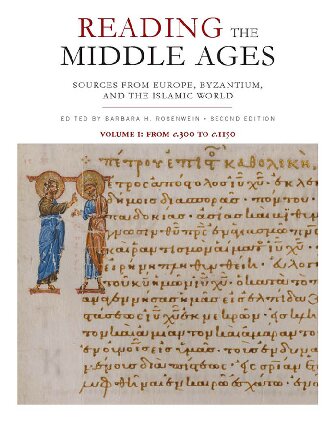
Reading the Middle Ages Volume I Sources from Europe Byzantium and the Islamic World c 300 to c 1150 2nd Edition by Barbara H Rosenwein ISBN 1442606053 978-1442606050


Original price was: $50.00.$35.00Current price is: $35.00.
Reading the Middle Ages Volume I Sources from Europe Byzantium and the Islamic World c.300 to c.1150 2nd Edition by Barbara H.Rosenwein – Ebook PDF Instant Download/Delivery:1442606053 ,978-1442606050
Full download Reading the Middle Ages Volume I Sources from Europe Byzantium and the Islamic World c.300 to c.1150 2nd Edition after payment
Product details:
ISBN 10:1442606053
ISBN 13:978-1442606050
Author:Barbara H.Rosenwein
Spanning the period from c.300 to c.1150 and containing primary source material from the European, Byzantine, and Islamic worlds, Barbara H. Rosenwein’s Reading the Middle Ages, Second Edition once again brings the Middle Ages to life. Building on the strengths of the first edition, this volume contains 20 new readings, including 8 translations commissioned especially for this book, and a stunning new 10-plate color insert entitled “Containing the Holy” that brings together materials from the Western, Byzantine, and Islamic religious traditions. Ancillary materials, including study questions, can be found on the History Matters
Table of contents:
I: PRELUDE: THE ROMAN WORLD TRANSFORMED
A Christianized Empire
Toleration or favoritism? Edict of Milan
Law: The Theodosian Code
Plague: Gregory the Great, Letter to Bishop Dominic of Carthage
Heresy and Orthodoxy
Heretics: A Donatist Sermon
Orthodoxy’s declaration: The Nicene Creed
Patristic Thought
Relating this world to the next: Augustine, The City of God
Monasticism: The Benedictine Rule
Saintly Models
The virginal life: Jerome, Letter 24 (To Marcella)
The eremetical life: Athanasius, Life of St. Antony of Egypt
The active life: Sulpicius Severus, The Life of St. Martin of Tours
St. Radegund as ascetic: Venantius Fortunatus, The Life of St. Radegund
St. Radegund as relic collector: Baudonivia, The Life of St. Radegund
Barbarian Kingdoms
Gothic Italy as Rome’s heir: Cassiodorus, Variae (State Papers)
Gothic Spain converts: The Third Council of Toledo
Merovingian Gaul’s bishop-historian: Gregory of Tours, History
Timeline for Chapter One
II: THE EMERGENCE OF SIBLING CULTURES
The Resilience of Byzantium
Byzantine village life and the education of a saint: The Life of St. Theodore of Sykeon
The argument for icons: John of Damascus, On Holy Images
The iconoclastic argument: The Synod of
Vilifying the iconoclasts: The Chronicle of Theophanes Confessor
The Formation of the Islamic World
Pre-Islamic Arabic poetry: Al-A‘sha, Bid Hurayra Farewell
The sacred text: Qur’an Suras
Umayyad diplomacy: The Treaty of Tudmir
Taxation: A Tax Demand in Egypt
Praising the caliph: Al-Akhtal, The Tribe Has Departed
The Impoverished but Inventive West
A world explained by words: Isidore of Seville, Etymologies
A modern martyr in Francia: The Passion of Leudegar
The settlement of disputes: Judgment of Childebert III
Reforming the Continental church: Letters to Boniface
Creating a Roman Christian identity for England: Bede, The Ecclesiastical History of the English People
Timeline for Chapter Two
III: CREATING NEW IDENTITIES
The Material Basis of Society
Manors in the West: Polyptyque of the Church of Saint Mary of Marseille
Byzantine guilds: The Book of the Prefect
Map: Major European Slave Exports
The sale of a slave in Italy: A Contract of Sale
The Abbasid Reconfiguration
An early view of the Prophet: Muhammad ibn Ishaq, Life of Muhammad
Hadith: Al-Bukhari, On Fasting
The “New Poetry”: Abu Nuwas, Turning the Tables
Al-Andalus
The minority—that is, Christian—view: Chronicle of Albelda
An Islamic Andalusian voice: Ibn ‘Abd Rabbihi, I Have Never Seen
A Jewish poet in al-Andalus: Dunash ben Labrat, There Came a Voice
The Western Church and Empire
The pope and the Carolingians: Pope Stephen II, Letters to King Pippin III
Charlemagne as Roman emperor: Einhard, Life of Charlemagne
Modeling the state on Old Testament Israel: The Admonitio Generalis
Ideals of family and fidelity: Dhuoda, Handbook for Her Son
Expanding Christianity
The Slavic conversion: Constantine/Cyril, Prologue to the Gospel
The Bulgarian Khan in Byzantine guise: Seal of Boris-Michael
The Bulgarians adopt Christianity: Pope Nicholas I, Letter to Answer the Bulgarians’ Questions
Timeline for Chapter Three
IV: POLITICAL COMMUNITIES REORDERED
Regionalism: Its Advantages and Its Discontents
Fragmentation in the Islamic world: Al-Tabari, The Defeat of the Zanj Revolt
The powerful in the Byzantine countryside: Romanus I Lecapenus, Novel
Donating to Cluny: Cluny’s Foundation Charter and various charters of donation
Love and complaints in Angoulême: Agreement between Count William of the Aquitanians and Hugh IV of Lusignan
The Peace of God at Bourges: Andrew of Fleury, The Miracles of St. Benedict
A castellan’s revenues and properties in Catalonia: Charter of Guillem Guifred
Byzantine Expansion
Military life: Constantine VII Porphyrogenitus, Military Advice to His Son
Imperial rule: Michael Psellus, Portrait of Basil II
Scholarship across the Islamic World
Education: Al-Qabisi, A Treatise Detailing the Circumstances of Students and the Rules Governing Teachers and Students
Political theory: Al-Farabi, The Perfect State
Logic: Ibn Sina (Avicenna), Treatise on Logic
Kingdoms in East Central Europe
Hungary as heir of Rome: King Stephen, Laws
Coming to terms with Catholic Poland: Thietmar of Merseburg, Chronicle
Poland’s self-image: Boleslaw’s Coin
Kievan Rus’: The Russian Primary Chronicle
Northern Europe
An Ottonian courtier/bishop: Ruotger, Life of Bruno, Archbishop of Cologne
Literacy: King Alfred, Prefaces to Gregory the Great’s Pastoral Care
Law: King Æthelred, Law Code
Christianity comes to Denmark: The Jelling Monument
People also search for:
readworks the middle ages introduction to the middle ages
during the middle ages who was reading
the middle ages introduction to the middle ages by readworks
the middle ages reading comprehension
guided reading activity the late middle ages
Tags: Barbara H Rosenwein, Reading, Middle, Ages