

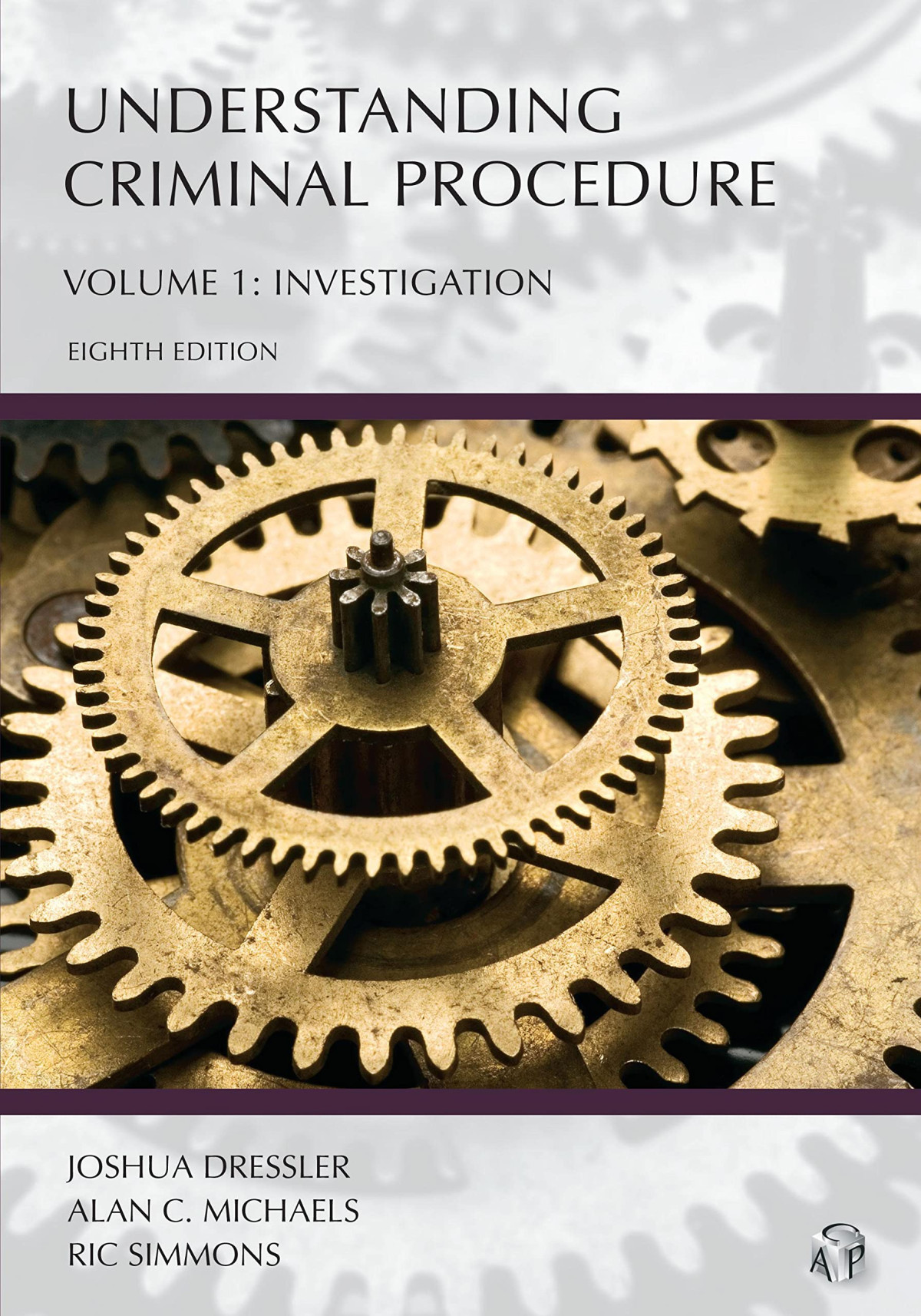
Understanding Criminal Procedure 8th Edition by Joshua Dressler, Alan C Michaels, Ric Simmons ISBN 1531021530 9781531021535


Original price was: $50.00.$35.00Current price is: $35.00.
Understanding Criminal Procedure 8th Edition by Joshua Dressler, Alan C. Michaels, Ric Simmons – Ebook PDF Instant Download/Delivery: 1531021530, 9781531021535
Full download Understanding Criminal Procedure 8th Edition after payment
Product details:
ISBN 10: 1531021530
ISBN 13: 9781531021535
Author: Joshua Dressler, Alan C. Michaels, Ric Simmons
Understanding Criminal Procedure 8th Table of contents:
Chapter 1 · Introduction to Criminal Procedure
§ 1.01 The Relationship of “Criminal Law” to “Criminal Procedure”
§ 1.02 Sources of Procedural Law[A] Formal Sources[B] Informal Sources: A Taste of Reality
§ 1.03 Stages of a Criminal Prosecution[A] In General[B] Investigatory Stage[C] Adjudicatory Stage
§ 1.04 Studying Constitutional Law Cases[A] Read Concurring and Dissenting Opinions[B] Learn Case Names[C] Count Votes[D] Learn the Views of Individual Justices[E] Be Sensitive to Supreme Court History
Chapter 2 · Overarching Policy Issues in Criminal Procedure
§ 2.01 Norms of the Criminal Process
§ 2.02 Alternative Models of Criminal Justice[A] Overview[B] Crime Control Model of Criminal Justice[C] Due Process Model of Criminal Justice
§ 2.03 The Role of “Truth” in the Criminal Justice System
§ 2.04 Accusatorial versus Inquisitorial Systems of Justice
§ 2.05 Race, Gender, and Economic Class in the Law
§ 2.06 Who Should Devise the Rules of Criminal Procedure?
§ 2.07 Formulating the Rules of Criminal Procedure: Some Overarching Controversies[A] Bright-Line Rules versus Case-by-Case Adjudication[B] Subjectivity versus Objectivity: Rule-Making to Avoid Pretextual Conduct
Chapter 3 · Incorporation of the Bill of Rights
§ 3.01 Incorporation: Overview[A] Nature of the Issue[B] Importance of the Debate
§ 3.02 Incorporation Theories[A] Full Incorporation[B] Fundamental Rights[C] Full-Incorporation-Plus[D] Selective Incorporation
§ 3.03 The Incorporation Debate[A] Overview of the Debate[B] What Did the Framers Intend?[C] Textual Claims: What Does “Due Process” Mean?[D] Which Doctrine Is More Libertarian?[E] Which Theory Is Structurally Preferable?
§ 3.04 Which Theory Has “Won” the Debate?
Chapter 4 · Fourth Amendment: Overview
§ 4.01 A Warning before Beginning the Fourth Amendment Journey
§ 4.02 The Text and Some (Hopefully) Useful Initial Observations
§ 4.03 What Does the Fourth Amendment Seek to Protect? An Overview[A] The Supreme Court’s View[B] The Reflections of Some Scholars
§ 4.04 Some Things to Know at the Outset[A] Standing to Raise Fourth Amendment Claims[B] Exclusionary Rule[C] Pretrial Nature of Fourth Amendment Issues[D] “Private” Searches and Seizures[E] The “Silver Platter” Doctrine[F] Who Are “the People” Protected by the Fourth Amendment?
§ 4.05 Fourth Amendment Checklist
Chapter 5 · Fourth Amendment: “Persons, Houses, Papers, and Effects”
§ 5.01 Significance of the Constitutional Phrase
§ 5.02 “Persons”
§ 5.03 “Houses”
§ 5.04 “Papers and Effects”
Chapter 6 · Fourth Amendment Terminology: “Search”
§ 6.01 Why “Search” Law Matters[A] Constitutional Significance of the Term “Search”[B] An Important Question for Further Consideration
§ 6.02 “Search”: Original “Trespass” Analysis
§ 6.03 “Search”: Katz v. United States and the “Privacy” Analysis[A] An Overview[B] Majority Opinion: In Search of a New Test[C] Concurring Opinion: A New “Search” Test[D] Analysis and Critique of the Katz Test[E] Jones and the Resurrection of the “Trespass” Test
§ 6.04 Post-Katz “Search” Jurisprudence: An Overview[A] What Has Katz Wrought?[B] Lurking Issues
§ 6.05 Surveillance of Conversations by “False Friends”[A] “False Friends” versus Katz[B] False Friends
§ 6.06 Open Fields[A] Rule and Rationale[B] “Open Field” versus “Curtilage”[C] Criticism of the Open-Fields Doctrine
§ 6.07 Aerial Surveillance[A] Rule[B] Surveillance by Airplanes[C] Surveillance by Helicopters
§ 6.08 Inspection of Garbage
§ 6.09 Use of Dogs and Other “Binary” Investigative Techniques to Discover Contraband[A] In General[B] Dog-Sniffs[C] Beyond Dogs
§ 6.10 Technological Information Gathering[A] In General[B] Pen Registers, Metadata, and the Third Party Doctrine[C] Electronic Tracking Devices: The “Beeper Cases”[D] Massive Data Collection and the Mosaic Theory[E] Computers and Electronic Transmissions
Chapter 7 · Fourth Amendment Terminology: “Seizure”
§ 7.01 Constitutional Significance of the Term “Seizure”
§ 7.02 Seizure of Property[A] General Rule[B] Special Issue: Installation of Electronic Devices on or in Personal Property
§ 7.03 Seizure of Persons[A] Overview[B] The Terry Definition[C] The Mendenhall “Reasonable Person” Test[D] Embellishment on the Terry-Mendenhall Test: The Submission-to-Authority Problem
Chapter 8 · Fourth Amendment: “Probable Cause”
§ 8.01 The Constitutional Role of “Probable Cause”
§ 8.02 Probable Cause: General Principles[A] “Probable Cause”: Definition[B] “Probable Cause”: Objective versus Subjective[C] “Probable Cause”: Arrests versus Searches[D] “Probable Cause”: With or Without Warrants[E] “Probable Cause”: Search for and Seize What?[F] Special Issue: “probable Cause” and Pretextual Police Conduct
§ 8.03 Determining “Probable Cause”: Overview[A] Types of Information: In General[B] “Bald and Unilluminating” Assertions[C] Direct Information[D] Hearsay (“Informant”) Information
§ 8.04 The Aguilar Two-Pronged Test[A] In General[B] Basis-of-Knowledge Prong[C] Veracity Prong[D] Corroboration
§ 8.05 The Gates “Totality of the Circumstances” Test[A] The Test Explained[B] Criticism of Gates
§ 8.06 Probable Cause in “Administrative Searches”: the Reasonableness Standard and the Camara Principle
§ 8.07 How Probable Is “Probable Cause”?[A] Governing Law[B] Reflections on the Issue[C] “Probable Cause” as a Sliding Scale?
Chapter 9 · Arrests
§ 9.01 “Arrest”: Overview[A] Definition[B] “Arrest” versus “Seizure”
§ 9.02 Arrests: Common Law and Statutory Arrest Rules
§ 9.03 Custodial Arrests for Minor Offenses
§ 9.04 Grounds for Arrest: “Stop and Identify” Statutes
§ 9.05 Arrest Warrants: Constitutional Law[A] Overview[B] Arrest in a Public Place: The No-Warrant Rule[C] Arrest in the Arrestee’s Home: The Warrant-Requirement Rule[D] Arrest in a Third Person’s Home
§ 9.06 Beyond Warrants: Executing an Arrest[A] Arrests in the Home: When and How Entry of the Residence Is Permitted[B] Force in Making an Arrest
§ 9.07 Beyond Warrants: Use of Force After Arrest
Chapter 10 · Search Warrants: In General
§ 10.01 The Constitutional Role of Search Warrants: The Debate[A] Nature and Significance of the Debate[B] the Substance of the Debate[C] Who Has “Won” the Debate?
§ 10.02 The Warrant Application Process
§ 10.03 Search Warrant Requirements[A] “Neutral and Detached Magistrate”[B] “Oath Or Affirmation”[C] “Particularity”
§ 10.04 Execution of Search Warrants[A] In Anticipation of Execution[B] Time of Execution[C] Means of Entry[D] Search of Persons While Executing a Warrant[E] Detention of Persons During Searches[F] Scope of the Search
Chapter 11 · Warrantless Searches: Exigent Circumstances
§ 11.01 Exigency Exception: Explained
§ 11.02 Intrusions Inside the Human Body
§ 11.03 External Searches of the Body
§ 11.04 Entry and Search of a Home
Chapter 12 · Searches Incident to Lawful Arrests
§ 12.01 Warrant Exception: In General[A] Rule[B] Rationale of the Warrant Exception[C] Probable Cause
§ 12.02 Warrant Exception: In Greater Detail[A] The Arrest[B] Contemporaneousness of the Search[C] Scope of the Search
§ 12.03 Chimel v. California: Setting the Rule’s Contours
§ 12.04 United States v. Robinson: The Traffic Arrest Case[A] The Holding[B] Robinson versus Chimel
§ 12.05 Searches of Automobiles Incident to Arrest[A] New York v. Belton[B] The Change Comes: Arizona v. Gant
§ 12.06 Riley v. California: The Cell Phone Case
Chapter 13 · Searches of Cars and Containers Therein
§ 13.01 Automobile Search Warrant Exception: General Rules[A] Important Overview[B] Searches “At the Scene”[C] Searches “Away From the Scene”[D] Probable Cause Requirement
§ 13.02 Automobile Search Warrant Exception: The “Mobility” Rationale[A] Carroll v. United States: True Mobility[B] Chambers v. Maroney: A Controversial View of “Mobility”[C] Coolidge v. New Hampshire: Departing from Chambers
§ 13.03 Automobile Search Warrant Exception: Lesser Privacy, a New Rationale
§ 13.04 California v. Carney: The Mobility and Lesser-Expectation-of-Privacy Rationales at Work
§ 13.05 Search of Containers Found in Cars[A] Clarification of the Issue[B] General Rule[C] Developing the Container Rules
Chapter 14 · “Plain View” and Related Doctrines
§ 14.01 Plain View: General Principles[A] Elements of the Doctrine[B] Rationale of the Doctrine
§ 14.02 “Plain View”: Examining the Elements in Detail[A] Element 1: Lawful Vantage Point[B] Element 2: Right of Access to the Object[C] Element 3: Right to Seize Is “Immediately Apparent”
§ 14.03 The Plain View Doctrine at Work: Arizona v. Hicks
§ 14.04 No “Inadvertent Discovery” Requirement
§ 14.05 Expanding on Plain View: Use of Other Senses[A] “Plain Hearing” and “Plain Smell” Doctrines[B] “Plain Touch” (or “Plain Feel”) Doctrine
Chapter 15 · Inventory Searches
§ 15.01 Automobile Inventories[A] General Principles[B] The Inventory Exception: In Detail
§ 15.02 Arrest Inventories
Chapter 16 · Consent Searches
§ 16.01 Preliminary Observations: Pragmatism, the Police, and the Supreme Court
§ 16.02 Consent Searches: General Principles[A] General Rule[B] Rationale for the Rule
§ 16.03 Voluntary Consent[A] Voluntariness: In General[B] Claim of Authority by the Police[C] Police Deception[D] Awareness of Fourth Amendment Rights
§ 16.04 Scope of Search
§ 16.05 Third-Party Consent
§ 16.06 “Apparent Authority”
Chapter 17 · Terry v. Ohio: The “Reasonableness” Balancing Standard in Criminal Investigations
§ 17.01 Terry v. Ohio: An Overview to a Landmark Case
§ 17.02 Terry v. Ohio: The Opinion[A] Majority Opinion[B] Justice Harlan’s Concurring Opinion
§ 17.03 “Reasonable Suspicion”[A] In General[B] Types of Information
§ 17.04 Distinguishing a “Terry stop” from an arrest[A] Overview to the Issue[B] Length of the Detention[C] Forcible Movement of the Suspect[D] Existence of “Less Intrusive Means”
§ 17.05 Grounds for “Terry Stops”[A] Crime Prevention versus Crime Detection[B] Nature of the Offense[C] Fingerprinting
§ 17.06 Weapons Searches: Of Persons[A] Permissibility[B] Method
§ 17.07 Extending Terry: Weapons Searches of Automobiles
§ 17.08 Extending Terry: Protective Sweeps of Residences
§ 17.09 Extending Terry: Temporary Seizures of Property
Chapter 18 · More “Reasonableness” Balancing: Searches and Seizures Primarily Conducted for Non-Criminal Law Purposes
§ 18.01 Overview
§ 18.02 Administrative Searches
§ 18.03 International Border Searches and Seizures[A] At the Border[B] Near the Border
§ 18.04 Automobile Inspections and Checkpoints[A] Automobile License and Vehicle Registration Inspections[B] Automobile Checkpoints
§ 18.05 “Special Needs” Searches and Seizures[A] In General[B] Searches of Persons, Personal Property, and Premises[C] Drug and Alcohol Testing
Chapter 19 · Fourth Amendment: Standing
§ 19.01 The Role of “Standing” in Fourth Amendment Law[A] In General[B] Is “Standing” a Separate Concept?
§ 19.02 Rationale of the Standing Requirement
§ 19.03 The Law of Standing: Pre-Rakas v. Illinois[A] In General[B] Automatic Standing
§ 19.04 Standing to Contest a Search: Rakas v. Illinois[A] The New Approach[B] The Impact of Rakas: A Closer Look
§ 19.05 Standing to Contest a Seizure: Post-Rakas
Chapter 20 · Fourth Amendment: Exclusionary Rule
§ 20.01 Historical Development of the Fourth Amendment Exclusionary Rule[A] Rights versus Remedies[B] Federal Exclusionary Rule: Weeks v. United States[C] Exclusionary Rule for the States?
§ 20.02 Rationale of the Exclusionary Rule
§ 20.03 Is the Exclusionary Rule Constitutionally Required?
§ 20.04 Exclusionary Rule: Should It Be Abolished?[A] Political and Historical Overview[B] Is There Historical Foundation for the Exclusionary Rule?[C] Does the Exclusionary Rule Deter Constitutional Violations?[D] Is the Rule (Even If It Deters) Worth Its Cost?[E] Are There Better Remedies?
§ 20.05 When the Exclusionary Rule Does Not Apply: In General[A] Non-Criminal Proceedings[B] Criminal Proceedings
§ 20.06 When the Exclusionary Rule Does Not Apply: The Police Culpability Factor[A] Historical Overview[B] The Culpability Approach in Its Infancy: United States v. Leon[C] Warrantless Searches: Moving Beyond Leon
§ 20.07 “Fruit of the Poisonous Tree” Doctrine[A] Warning: Hudson v. Michigan[B] Conceptual Overview[C] Independent Source Doctrine[D] Inevitable Discovery Rule[E] Attenuated Connection Principle (The Wong Sun Rule)
Chapter 21 · Interrogation Law: Overview
§ 21.01 Reflections on Modern Interrogation Law
§ 21.02 Police Interrogation Techniques: Historically and at Present
§ 21.03 Interrogation Law: Constitutional Issues[A] Was the Confession Obtained Involuntarily (or By Coercion)?[B] Was the Confession Obtained in Violation of Miranda v. Arizona?[C] Was the Defendant Entitled to Counsel?
§ 21.04 Interrogation Law: An Overview to the Policy Debate[A] Societal Ambivalence Regarding Confessions[B] Has the Law Gone Far Enough—or Too Far—in Controlling Confessions?[C] Questions to Think About
Chapter 22 · Interrogation Law: Due Process Clause
§ 22.01 Historical Development[A] Common Law[B] Constitutional Law
§ 22.02 Due Process Clause: the Voluntariness Requirement[A] General Principles[B] The Voluntariness Requirement in Greater Detail
§ 22.03 Due Process Clause: Remedies for Violation of the Right[A] Requirement of State Action (Official Overreaching)[B] Standing to Raise an Involuntary Confession Claim[C] Exclusionary Rule
Chapter 23 · Interrogation Law: Privilege Against Compelled Self-Incrimination
§ 23.01 Fifth Amendment Self-Incrimination Clause: Overview
§ 23.02 The Origins of the Privilege Against Self-Incrimination
§ 23.03 Is the Privilege a Good Idea? The Controversy[A] In General[B] The Modern Debate
§ 23.04 The Fifth Amendment Privilege: The Elements[A] “No Person”[B] “Shall Be Compelled”[C] “In Any Criminal Case”[D] “To Be a Witness Against Himself”
§ 23.05 Privilege Against Self-Incrimination in the Police Interrogation Context[A] General Principles[B] Remedies for Violation of the Fifth Amendment Privilege
Chapter 24 · Interrogation Law: Miranda v. Arizona
§ 24.01 Miranda: A Brief Overview and Some Reflections
§ 24.02 Miranda: Placing the Case in Historical Context
§ 24.03 The Road to Miranda: Escobedo v. Illinois
§ 24.04 Miranda: The Case[A] The Facts[B] The Holding[C] Reasoning of the Court
§ 24.05 Criticisms of Miranda[A] “Miranda Did Not Go Far Enough”[B] “Miranda Went Too Far”
§ 24.06 Is Miranda a Constitutionally Based Decision?[A] Act 1: Congress and Miranda[B] Act 2: Miranda as a “Prophylactic Rule”[C] Act 3: Miranda Is (Sort of) Re-Constitutionalized
§ 24.07 Meaning of Miranda: “Custody”[A] General Principles[B] Commonly Asked “Custody” Questions
§ 24.08 Meaning of Miranda: “Interrogation”[A] In General[B] When Is an Interrogation Not a Miranda “Interrogation”?
§ 24.09 Adequacy of Miranda Warnings
§ 24.10 Waiver of Miranda Rights[A] In General[B] Waiver Law: If a Suspect Invokes His Rights
§ 24.11 Custodial Interrogation: When Miranda Warnings Are Not Required[A] Public-Safety Exception[B] Covert Custodial Interrogation[C] Routine-Booking-Questions Exception
§ 24.12 Scope of the Miranda Exclusionary Rule[A] Impeachment Exception[B] Fruit-of-the-Poisonous-Tree Doctrine
Chapter 25 · Interrogation Law: Sixth Amendment Right to Counsel
§ 25.01 Massiah v. United States[A] Historical Overview[B] Massiah: The Opinion[C] Making Sense of Massiah: The Sixth Amendment Role of Counsel
§ 25.02 The Sixth Amendment (Massiah) Right to Counsel: Summary
§ 25.03 Procedural Initiation of the Right to Counsel: Adversary Judicial Proceedings
§ 25.04 “Offense-Specific” Nature of the Right to Counsel
§ 25.05 Requirement of “Deliberate Elicitation”[A] “Deliberate Elicitation” versus “Interrogation”[B] What Does “Deliberate” Mean?[C] What Is “Elicitation”?
§ 25.06 Waiver of the Right to Counsel[A] General Principles[B] The Court’s First Waiver Case: Brewer v. Williams[C] Seeking Waiver[D] Elements of a Valid Waiver
§ 25.07 Scope of the Sixth Amendment Exclusionary Rule[A] Right or Remedy?[B] When the Police Investigate “Sixth Amendment” and “Non-Sixth Amendment” Offenses[C] Use of Evidence for Impeachment Purposes[D] Fruit-of-the-Poisonous-Tree Doctrine
§ 25.08 Right-to-Counsel Summary: Sixth Amendment versus Miranda
Chapter 26 · Eyewitness Identification Procedures
§ 26.01 Eyewitness Identification: The Problem and Potential Safeguards[A] The Problem[B] Non-Constitutional Reform Measures
§ 26.02 Corporeal Identification Procedures: Right to Counsel[A] Rule[B] How the Rule Developed[C] The Role of Counsel in the Identification Process
§ 26.03 Non-Corporeal Identification Procedures: Right to Counsel
§ 26.04 Identification Procedures: Due Process of Law
Chapter 27 · Entrapment
§ 27.01 Entrapment: In General
§ 27.02 Entrapment: The Subjective Test[A] Rule[B] Rationale of the Rule[C] Procedural Features of the Rule
§ 27.03 Entrapment: The Objective Test[A] Rule[B] Rationale of the Rule[C] Procedural Features of the Rule
§ 27.04 Entrapment: The Debate[A] Overview[B] Criticisms of the Subjective Test[C] Criticisms of the Objective Test
§ 27.05 Entrapment: Due Process
Chapter 28 · The Right to Counsel: At Trial and on Appeal
§ 28.01 Overview: The Importance of Defense Lawyers in the Adversary System
§ 28.02 When the Right to Counsel Applies
§ 28.03 The Right to Counsel: at Trial[A] the Right to Employ Counsel[B] Indigents: the Right to Appointed Counsel
§ 28.04 The Right to Counsel: On Appeal[A] Inapplicability of the Sixth Amendment[B] First Appeal (as of Right)[C] Subsequent (Discretionary) Appeals[D] First (Discretionary) Appeal after a Guilty Plea
§ 28.05 The Right of Self-Representation[A] The Defense: Who Is in Charge?[B] Faretta v. California[C] Procedural Issues
§ 28.06 The Right to Representation by One’s Preferred Attorney[A] In General[B] Special Problem: Seizing Lawyers’ Fees
§ 28.07 Interference with the Right to Counsel
§ 28.08 Effective Assistance of Counsel: General Principles[A] Nature of the Issue[B] “Ineffective Assistance”: The Strickland Test
§ 28.09 Effective Assistance of Counsel: Conflicts of Interest[A] Nature of the Issue[B] Pretrial Procedures to Avoid Conflicts[C] Post-Trial Proof of a Conflict[D] Waiver of the Right to Conflict-Free Representation
§ 28.10 Effective Assistance: The Role of Ethical Canons
People also search for Understanding Criminal Procedure 8th:
understanding criminal procedure pdf
understanding criminal procedure adjudication
understanding criminal procedure investigation
understanding criminal procedure volume 1 investigation
understanding criminal procedure volume 1
Tags: Joshua Dressler, Alan C Michaels, Ric Simmons, Criminal Procedure