

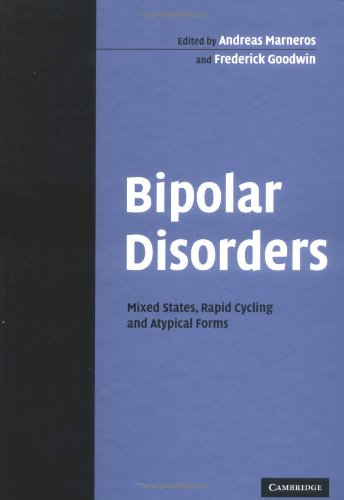
Bipolar Disorders Mixed States Rapid Cycling and Atypical Forms 1st Edition by Andreas Marneros, Frederick Goodwin 0521835178 9780521835176

Original price was: $50.00.$35.00Current price is: $35.00.
Bipolar Disorders Mixed States Rapid Cycling and Atypical Forms 1st Edition by Andreas Marneros, Frederick Goodwin – Ebook PDF Instant Download/Delivery: 0521835178, 9780521835176
Full download Bipolar Disorders Mixed States Rapid Cycling and Atypical Forms 1st Edition after payment
Product details
ISBN 10: 0521835178
ISBN 13: 9780521835176
Author: Andreas Marneros, Frederick Goodwin
Bipolar disorder manifests itself in a variety of forms. It can coexist with other psychiatric conditions, and treatment efficacy can depend on the type of bipolar state. This book covers the full range of atypical, rapid cycling and transient forms of bipolar disorder, from atypical and agitated depression to schizoaffective mixed states. The most recent ICD category is covered, and the authors also look at the biology and genetics of bipolar disorder, along with issues relating to age (children and the elderly), comorbidity, choice of drug treatment and investigational strategies.
Bipolar Disorders Mixed States Rapid Cycling and Atypical Forms 1st Table of contents
1 Bipolar disorders beyond major depression and euphoric mania
Introduction: knowledge from the past, goals for the future
Mixed states
The ancient times
From Heinroth to the psychopharmacological revolution
The renaissance of mixed states
Frequency
Phenomenology
Onset, course, and outcome
Comorbidity
Family history
Treatment
Future perspectives on mixed states
Rapid cycling
Age at onset
Family studies and genetics
Biological data
Comorbidity
Longitudinal prognosis
Treatment
Bipolar schizoaffective mixed states
Atypical depressions
Polymorphic psychotic disorders as a possible atypical bipolar disorder
Lessons from the past and options for the future
REFERENCES
2 Emerging concepts of mixed states: a longitudinal perspective
Definition of bipolar mixed states
Dysphoric mania
Toward a broader definition of mixed mania
Depressive mixed states
Bipolar II and unipolar depressive mixed states
Long-term aspects of mixed states
Conclusions
REFERENCES
3 Rapid-cycling bipolar disorder
Introduction
Family genetics
Pathophysiology
Epidemiology, phenomenology, and comorbidity
Pharmacotherapy
Treatment recommendations
Lamotrigine
Clinical response
Lithium
Divalproex sodium
Olanzapine
Quetiapine
Combination therapy
REFERENCES
4 Bipolar I and bipolar II: a dichotomy?
Introduction
Is there a true dichotomy between bipolar I and bipolar II disorder?
Epidemiologic studies
Age at onset
Clinical course and outcome
Pathophysiology
Family studies and genetics
Neuroimage
Neurochemical studies
Neurophysiology
Treatment
Conclusion
Acknowledgments
REFERENCES
5 Recurrent brief depression as an indicator of severe mood disorders
Introduction
Bipolar spectrum
Recurrent brief psychiatric syndromes
Methodology
Sample
Interviews
Definitions
Bipolar spectrum
Depressive spectrum
Recurrent brief psychiatric syndromes
Combined syndromes
Rapid cycling and seasonality
Treatment and distress
Personality
Statistics
Results
Recurrent brief psychiatric syndromes and their overlap
The value of RBD, RBM, and hypomanic symptoms as a predictor of BP-II disorder
Combined versus pure mood disorders (Table 5.2)
Gender
Diagnostic overlap
Family history
Clinical characteristics
Onset and course
Associations with other psychiatric disorders
Personality
Suicide attempts
Discussion
Prevalence
Comorbidity
Risk of suicide attempts
What is the nature of RBD?
Treatment of RBD and CD
Conclusion
Acknowledgment
REFERENCES
6 Atypical depression and its relation to bipolar spectrum
Introduction: the relationship of atypical depression to bipolar II disorder
Recent literature review
The author’s studies
Is AD more common in BP-II versus UP?
Is BP-II versus UP difference in AD frequency age-related?
Is there a difference in AD frequency in BP-II samples when probing for past hypomania focused on ov
Is AD frequency still higher in BP-II versus UP when BP-II had a short hypomania?
Is AD a predictor of BP-II?
Can AD increase the probability of UP switching into hypomania?
Is there any difference in AD frequency in early-onset versus late-onset BP-II?
Is there any difference between BP-II AD and UP AD?
Is there a link between BP-II and UP AD?
What is the relationship between AD and age?
Are there differences between AD and non-AD?
Is there any difference between early-onset and late-onset AD?
What is the relationship between AD and chronic depression?
Are females more common in AD versus non-AD?
Is AD a moderate-severity depression?
Is there a link between depressive mixed state and AD?
Is there a link between female gender and AD in depressive mixed state?
Is psychomotor retardation more common in AD versus non-AD?
Is there a link between recurrences and AD?
What is the relationship between AD and psychotic features?
What is the relationship between AD and menopause?
The author’s last sample study on atypical depression
Study methods
Interviewer
Study setting
Patients and interview
Statistics
Results
Conclusions
REFERENCES
7 Agitated depression: spontaneous and induced
Introduction
Melancholia agitata
Mixed affective states and agitated depression
The parallelism between drive, mood, and thought
Clinical picture of agitated depression
Clinical forms of agitated depression
Psychotic agitated depression
Agitated depression (non-psychotic) with psychomotor agitation
Minor agitated depression
Flight of ideas, racing and crowded thoughts
Restlessness, inner agitation, and anxiety
Role of temperament
The nature and definition of agitated depression
Diagnostic criteria of agitated depression
Patients and method
Spontaneous and induced agitated depression
Latent agitated depression
Treatment
Outcome
Treatment with olanzapine
Agitated depression followed by simple depression
Conclusions
REFERENCES
8 Schizoaffective mixed states
Introduction
Developments of the definition of schizoaffective disorders
Current research in schizoaffective mixed states
Schizoaffective mixed states in the Cologne study
The Halle Bipolarity Longitudinal Study
Results
Characteristics of episodes
Duration of episodes
Frequency of patients having mixed episodes
Gender distribution
Initial episode and first manifestation of a mixed episode
Disability pensions
Conclusions
REFERENCES
9 Acute and transient psychotic disorder: an atypical bipolar disorder?
Introduction
Definitions of acute and transient psychotic disorders
Acute onset
Typical syndromes
Acute stress
The predecessors of the acute and transient psychotic disorders
Cycloid psychoses
Bouff?e d?lirante
Other predecessors
What are acute and transient psychotic disorders?
Methods of the HASBAP
Results
ATPD versus bipolar affective mixed states versus bipolar schizoaffective mixed states
Polymorphic subgroup of ATPD versus bipolar affective mixed versus bipolar schizoaffective mixed sta
ATPD versus all mixed states (affective plus schizoaffective)
Polymorphic subgroup versus all mixed (affective and schizoaffective)
ATPD versus the groups of bipolar affective mixed, bipolar schizoaffective mixed, bipolar affective
Conclusions
References
10 Bipolar disorder in children and adolescents
Introduction
Prevalence
Clinical diagnoses
Longitudinal course
Family history
Bottom-up studies
Top-down studies
Treatment
Summary
Acknowledgment
REFERENCES
11 Atypical features of bipolarity in old age
Introduction
Atypical features
Age of onset and clinical course
Neurologic comorbidity
Cognitive impairment
Nosologic confusion
Proposed subtypes
Atypical treatment issues
References
12 Comorbidity in mixed states and rapid-cycling forms of bipolar disorders
Relevance of comorbidity
Medical conditions and neuropsychiatric disorders
Substance-abuse disorders
Anxiety disorders
Personality disorders
Other psychiatric disorders
The general effect of comorbidity
Conclusions
References
13 Challenges in the genetics of bipolar disorder
Epidemiology of mood disorders
Genetic epidemiology of mood disorders in adults
Family studies
Review of empirical evidence
Factors associated with familial transmission of mood disorders
Relationship to the proband
Age of onset
Sex of proband
Twin studies of mood disorders
Adoption studies of the mood disorders
Genetic epidemiology of mood disorders in youth
Family studies
Twin studies
Age
Genetic marker studies of mood disorders
Association studies of mood disorders
Review of empirical evidence
Linkage studies of mood disorders
Review of empirical evidence
Challenges to the identification of genes for mood disorders
Psychiatric disorder phenotypes
Lack of direct correspondence between the genotype and phenotype
Gene?environment interaction
Future directions
References
14 Biological aspects of rapid cycling and mixed states
Introduction
Implications of catecholamines on mixed states and rapid cycling
Implications of hormonal aberrations on mixed states and rapid cycling
The impact of transmembranous ion fluxes on rapid cycling and mixed states
How do antiepileptic drugs used in treating mixed states and rapid cycling potentially interfere wit
Other mechanisms of mood stabilizers possibly related to rapid cycling and mixed states
Conclusions
References
15 The treatment of bipolar mixed states
Mixture of elements (mood, activity, thinking)
Severe stage of mania
Dysphoric mania
Depression as characterological response to mania
Manic defense in depression
Transition state during a cycle: MDI/DMI
Mixed states in predominantly depressed bipolar patients (BP-II, Dm)
Modified by substance misuse
Modified by organic brain disease
Ultrarapid cycling
With mood-incongruent psychotic features
Schizoaffective mixed states
Clinical trials in mania and mixed states
Treatment responses in different models of mixed states
Antipsychotics in mania
Cortisol levels during response to antipsychotics
Antipsychotics, depression in mania, and switch into depression
“Manic defense,” transitions, and treatment of mania
Antipsychotics in prophylaxis of bipolar disorder
Lamotrigine
Treatment of mixed states with antidepressants
Antidepressants in bipolar mixed states
Resistance to treatment in mixed states
Combining lithium and antidepressants in prophylaxis of mixed mania
Suicide risk
Conclusions
References
16 The use of atypical antipsychotic agents in the treatment of diagnostic subgroups of bipolar diso
Introduction
Controlled studies of atypical antipsychotic medications in bipolar disorder
Method
Clozapine
Risperidone
Olanzapine
Quetiapine
Ziprasidone
Aripiprazole
Use of atypical antipsychotic medications in mania: psychotic and non-psychotic patients
References
17 Investigational strategies: treatment of rapid cycling, mixed episodes, and atypical bipolar mood
Difficulties in conducting clinical trials for atypical bipolar disorder
Difficulties in conducting clinical trials for mixed episodes
Difficulties in conducting clinical trials for rapid cycling
What are the lessons from clinical trials for rapid cycling?
Rapid cycling: clinical trial design issues
Conclusion
Definitions
Current rapid cycling
History of rapid cycling
Secondary rapid cycling
Primary rapid cycling
Defining a phase shift
Acknowledgment
References
People also search for Bipolar Disorders Mixed States Rapid Cycling and Atypical Forms 1st
bipolar disorders mixed states
rapid cycling bipolar disorder book
bipolar disorder atypical forms pdf
mixed affective states bipolar disorder
bipolar spectrum disorders textbook
Tags: Bipolar Disorders, States, Rapid Cycling, Atypical Forms, Andreas Marneros, Frederick Goodwin