

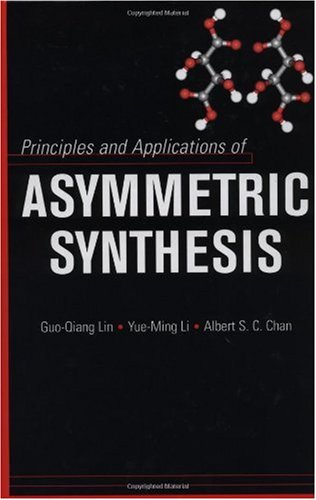

Principles and Applications of Asymmetric Synthesis 1st Edition by Guo Qiang Lin, Yue Ming Li, Albert SC Chan – Ebook PDF Instant Download/Delivery: 0471465240, 9780471465249
Full download Principles and Applications of Asymmetric Synthesis 1st Edition after payment

Product details:
ISBN 10: 0471465240
ISBN 13: 9780471465249
Author: Guo Qiang Lin, Yue Ming Li, Albert SC Chan
Authored by internationally renowned scientists in the field, this reliable reference covers more than 450 reactions and includes important stoichiometric as well as catalytic asymmetric reactions. The first chapter reviews the basic principles, common nomenclature, and analytical methods, and the remainder of the book is organized according to reaction type. The text examines such topics as:
- Carbon-carbon bond formations involving carbonyls, enamines, imines, and enolates
- Asymmetric C-O bond formations including epoxidation, dihydroxylation, and aminohydroxylation
- Asymmetric synthesis using the Diels-Alder reaction and other cyclizations
- Applications to the total synthesis of natural products
- Use of enzymes in asymmetric synthesis
Practicing chemists in the pharmaceutical, fine chemical, and agricultural professions as well as graduate students will find that Principles and Applications of Asymmetric Synthesis affords comprehensive and current coverage.
Principles and Applications of Asymmetric Synthesis 1st Table of contents:
Chapter 1: Fundamentals of Stereochemistry and Chirality
1.1 chirality and molecular symmetry
1.2 stereoisomerism and stereogenic centers
1.3 enantiomers and diastereomers
1.4 optical activity and chiroptical techniques
1.5 conformational analysis and stereochemical control
Chapter 2: Mechanistic Principles of Asymmetric Reactions
2.1 chiral reagents and chiral auxiliaries
2.2 transition state models for stereocontrol
2.3 substrate-directed asymmetric induction
2.4 reagent-controlled asymmetric synthesis
2.5 kinetic versus thermodynamic control in chiral outcomes
Chapter 3: Catalytic Asymmetric Synthesis
3.1 introduction to chiral catalysts
3.2 organocatalysis and small-molecule strategies
3.3 metal-catalyzed asymmetric reactions
3.4 enzymatic and biocatalytic asymmetric synthesis
3.5 chiral Lewis acids and asymmetric hydrogenation
Chapter 4: Asymmetric Inductions in Carbon–Carbon Bond Formation
4.1 aldol reactions with asymmetric control
4.2 asymmetric Michael addition reactions
4.3 enantioselective alkylations and allylation
4.4 proline-based and secondary amine organocatalysts
4.5 stereoselective carbonyl additions
Chapter 5: Asymmetric Heteroatom Chemistry
5.1 enantioselective oxidations and reductions
5.2 asymmetric epoxidation and dihydroxylation
5.3 asymmetric amination and hydrazination reactions
5.4 enantioselective C–H functionalization
5.5 chiral catalysts in heteroatom transfers
Chapter 6: Total Synthesis of Natural Products via Asymmetric Strategies
6.1 case studies in asymmetric total synthesis
6.2 synthetic design using chiral pool building blocks
6.3 relay strategies using sequential asymmetric steps
6.4 cascade and tandem reactions for stereoselectivity
6.5 multistep synthesis with high enantioselectivity
Chapter 7: Asymmetric Synthesis in Pharmaceutical Development
7.1 chiral drugs and regulatory requirements
7.2 scalable asymmetric processes in industry
7.3 process development and optimization
7.4 analytical methods for enantiomeric purity
7.5 case studies: chiral drug molecules
Chapter 8: Emerging Trends and Future Directions in Asymmetric Synthesis
8.1 green chemistry and sustainable asymmetric methods
8.2 flow chemistry and process intensification
8.3 photochemical and electrochemical asymmetric synthesis
8.4 computational design in asymmetric catalysis
8.5 machine learning for catalyst and reaction prediction
People also search for Principles and Applications of Asymmetric Synthesis 1st:
application of asymmetric synthesis
principle of asymmetric synthesis
what is asymmetric synthesis
principle and application of nmr
importance of asymmetric synthesis
Tags: Guo Qiang Lin, Yue Ming Li, Albert SC Chan, Principles, Asymmetric


