

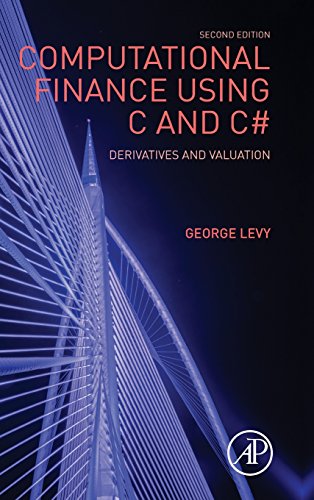
Computational Finance Using C and C Derivatives and Valuation 2nd Edition by George Levy ISBN 012803579X 9780128035795


Original price was: $50.00.$35.00Current price is: $35.00.
Computational Finance Using C and C Derivatives and Valuation 2nd Edition by George Levy – Ebook PDF Instant Download/Delivery: 012803579X, 9780128035795
Full download Computational Finance Using C and C Derivatives and Valuation 2nd Edition after payment
Product details:
ISBN 10: 012803579X
ISBN 13: 9780128035795
Author: George Levy
Computational Finance Using C and C#: Derivatives and Valuation, Second Edition provides derivatives pricing information for equity derivatives, interest rate derivatives, foreign exchange derivatives, and credit derivatives. By providing free access to code from a variety of computer languages, such as Visual Basic/Excel, C++, C, and C#, it gives readers stand-alone examples that they can explore before delving into creating their own applications. It is written for readers with backgrounds in basic calculus, linear algebra, and probability. Strong on mathematical theory, this second edition helps empower readers to solve their own problems.
*Features new programming problems, examples, and exercises for each chapter. *Includes freely-accessible source code in languages such as C, C++, VBA, C#, and Excel.. *Includes a new chapter on the history of finance which also covers the 2008 credit crisis and the use of mortgage backed securities, CDSs and CDOs. *Emphasizes mathematical theory.
- Features new programming problems, examples, and exercises with solutions added to each chapter
- Includes freely-accessible source code in languages such as C, C++, VBA, C#, Excel,
- Includes a new chapter on the credit crisis of 2008
- Emphasizes mathematical theory
Computational Finance Using C and C Derivatives and Valuation 2nd Table of contents:
1 Overview of Financial Derivatives
2 Introduction to Stochastic Processes
2.1 Brownian Motion
2.2 A Brownian Model of Asset Price Movements
2.3 Ito’s Formula (or Lemma)
2.4 Girsanov’s Theorem
2.5 Ito’s Lemma for Multi-Asset GBM
2.6 Ito Product and Quotient Rules in Two Dimensions
2.6.1 Ito Product Rule
2.6.2 Ito Quotient Rule
2.7 Ito Product in n Dimensions
2.8 The Brownian Bridge
2.9 Time Transformed Brownian Motion
2.9.1 Scaled Brownian Motion
2.9.2 Mean Reverting Process
2.10 Ornstein Uhlenbeck Process
2.11 The Ornstein Uhlenbeck Bridge
2.12 Other Useful Results
2.12.1 Fubini’s Theorem
2.12.2 Ito’s Isometry
2.12.3 Expectation of a Stochastic Integral
2.13 Selected Exercises
3 Generation of Random Variates
3.1 Introduction
3.2 Pseudo-Random and Quasi-Random Sequences
3.3 Generation of Multivariate Distributions: Independent Variates
3.3.1 Normal Distribution
3.3.2 Lognormal Distribution
3.3.3 Student’s t-Distribution
3.4 Generation of Multivariate Distributions: Correlated Variates
3.4.1 Estimation of Correlation and Covariance
3.4.2 Repairing Correlation and Covariance Matrices
3.4.3 Normal Distribution
3.4.4 Lognormal Distribution
3.5 Selected Exercises
4 European Options
4.1 Introduction
4.2 Pricing Derivatives using A Martingale Measure
4.3 Put Call Parity
4.3.1 Discrete Dividends
4.3.2 Continuous Dividends
4.4 Vanilla Options and the Black21Scholes Model
4.4.1 The Option Pricing Partial Differential Equation
4.4.2 The Multi-asset Option Pricing Partial Differential Equation
4.4.3 The Black–Scholes Formula
4.4.4 Historical and Implied Volatility
4.4.5 Pricing Options with Microsoft Excel
4.5 Barrier Options
4.5.1 Introduction
4.5.2 Analytic Pricing of Down and Out Call Options
4.5.3 Analytic Pricing of Up and Out Call Options
4.5.4 Monte Carlo Pricing of Down and Out Options
4.6 Selected Exercises
5 Single Asset American Options
5.1 Introduction
5.2 Approximations for Vanilla American Options
5.2.1 American Call Options with Cash Dividends
5.2.2 The Macmillan, Barone-Adesi, and Whaley Method
5.3 Lattice Methods for Vanilla Options
5.3.1 Binomial Lattice
5.3.2 Constructing and using the Binomial Lattice
5.3.3 Binomial Lattice with a Control Variate
5.3.4 The Binomial Lattice with BBS and BBSR
5.4 Grid Methods for Vanilla Options
5.4.1 Introduction
5.4.2 Uniform Grids
5.4.3 Nonuniform Grids
5.4.4 The Log Transformation and Uniform Grids
5.4.5 The Log Transformation and Nonuniform Grids
5.4.6 The Double Knockout Call Option
5.5 Pricing American Options using a Stochastic Lattice
5.6 Selected Exercises
6 Multi-asset Options
6.1 Introduction
6.2 The Multi-asset Black21Scholes Equation
6.3 Multidimensional Monte Carlo Methods
6.4 Introduction to Multidimensional Lattice Methods
6.5 Two-asset Options
6.5.1 European Exchange Options
6.5.2 European Options on the Maximum or Minimum
6.5.3 American Options
6.6 Three-asset Options
6.7 Four-asset Options
6.8 Selected Exercises
7 Other Financial Derivatives
7.1 Introduction
7.2 Interest Rate Derivatives
7.2.1 Forward Rate Agreement
7.2.2 Interest Rate Swap
7.2.3 Timing Adjustment
7.2.4 Interest Rate Quantos
7.3 Foreign Exchange Derivatives
7.3.1 FX Forward
7.3.2 European FX Option
7.4 Credit Derivatives
7.4.1 Defaultable Bond
7.4.2 Credit Default Swap
7.4.3 Total Return Swap
7.5 Equity Derivatives
7.5.1 TRS
7.5.2 Equity Quantos
7.6 Selected Exercises
8 C# Portfolio Pricing Application
8.1 Introduction
8.2 Storing and Retrieving the Market Data
8.3 Equity Deal Classes
8.3.1 Single Equity Option
8.3.2 Option on Two Equities
8.3.3 Generic Equity Basket Option
8.3.4 Equity Barrier Option
8.4 FX Deal Classes
8.4.1 FX Forward
8.4.2 Single FX Option
8.4.3 FX Barrier Option
8.5 Selected Exercises
9 A Brief History of Finance
9.1 Introduction
9.2 Early History
9.2.1 The Sumerians
9.2.2 Biblical Times
9.2.3 The Greeks
9.2.4 Medieval Europe
9.3 Early Stock Exchanges
9.3.1 The Anwterp Exchange
9.3.2 Amsterdam Stock Exchange
9.3.3 Other Early Financial Centres
9.4 Tulip Mania
9.5 Early Use of Derivatives in the USA
9.6 Securitisation and Structured Products
9.7 Collateralised Debt Obligations
9.8 The 2008 Financial Crisis
9.8.1 The Collapse of AIG
A The Greeks for Vanilla European Options
A.1 Introduction
A.2 Gamma
A.3 Delta
A.4 Theta
A.5 Rho
A.6 Vega
B Barrier Option Integrals
B.1 The Down and Out Call
B.2 The Up and Out Call
C Standard Statistical Results
C.1 The Law of Large Numbers
C.2 The Central Limit Theorem
C.3 The Variance and Covariance of Random Variables
C.3.1 Variance
C.3.2 Covariance
C.3.3 Covariance Matrix
C.4 Conditional Mean and Covariance of Normal Distributions
C.5 Moment Generating Functions
D Statistical Distribution Functions
D.1 The Normal (Gaussian) Distribution
D.2 The Lognormal Distribution
D.3 The Student’s t Distribution
D.4 The General Error Distribution
D.4.1 Value of for Variance hi
D.4.2 The Kurtosis
D.4.3 The Distribution for Shape Parameter, a
E Mathematical Reference
E.1 Standard Integrals
E.2 Gamma Function
E.3 The Cumulative Normal Distribution Function
E.4 Arithmetic and Geometric Progressions
F Black21Scholes Finite-Difference Schemes
F.1 The General Case
F.2 The Log Transformation and a Uniform Grid
G The Brownian Bridge: Alternative Derivation
H Brownian Motion: More Results
H.1 Some Results Concerning Brownian Motion
H.2 Proof of Equation (H.1.2)
H.3 Proof of Equation (H.1.4)
H.4 Proof of Equation (H.1.5)
H.5 Proof of Equation (H.1.6)
H.6 Proof of Equation (H.1.7)
H.7 Proof of Equation (H.1.8)
H.8 Proof of Equation (H.1.9)
H.9 Proof of Equation (H.1.10)
I Feynman21Kac Formula
I.1 Some Results
People also search for Computational Finance Using C and C Derivatives and Valuation 2nd:
computational finance cmu undergraduate
computational finance cmu
computational finance courses
computational finance using c and c#
computational finance and risk management
Tags:
George Levy,Finance,C Derivatives