

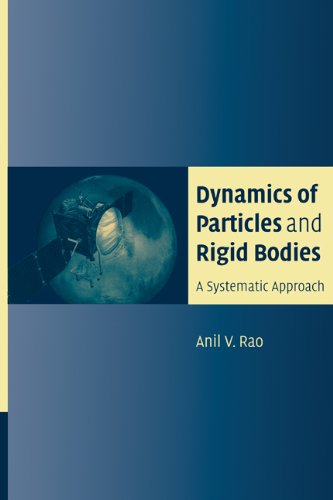
Dynamics of Particles and Rigid Bodies A Systematic Approach 1st Edition by Anil Rao ISBN 0521858119 9780521858113


Original price was: $50.00.$35.00Current price is: $35.00.
Dynamics of Particles and Rigid Bodies A Systematic Approach 1st Edition by Anil Rao – Ebook PDF Instant Download/Delivery: 0521858119, 9780521858113
Full download Dynamics of Particles and Rigid Bodies A Systematic Approach 1st Edition after payment
Product details:
ISBN 10: 0521858119
ISBN 13: 9780521858113
Author: Anil Rao
Dynamics of Particles and Rigid Bodies A Systematic Approach 1st Table of contents:
Chapter 1: Introductory Concepts
-
1.1 Scalars
-
1.2 Vectors
-
1.2.1 Types of Vectors
-
1.2.2 Addition of Vectors
-
1.2.3 Components of a Vector
-
1.2.4 Multiplication of a Vector by a Scalar
-
1.2.5 Scalar Product
-
1.2.6 Vector Product
-
1.2.7 Scalar Triple Product
-
1.2.8 Vector Triple Product
-
-
1.3 Tensors
-
1.3.1 Important Classes of Tensors
-
1.3.2 Tensor Product Between Vectors
-
1.3.3 Basis Representations of Tensors
-
-
1.4 Matrices
-
1.4.1 Systems of Linear Equations
-
1.4.2 Classes of Matrices
-
1.4.3 Relationship Between Tensors and Matrices
-
1.4.4 Transformation of Column-Vectors and Row-Vectors
-
1.4.5 Transformation of Matrices
-
1.4.6 Eigenvalues and Eigenvectors
-
1.4.7 Eigenvalues and Eigenvectors of a Real-Symmetric Matrix
-
-
1.5 Ordinary Differential Equations
Chapter 2: Kinematics
-
2.1 Reference Frames
-
2.1.1 Definition of a Reference Frame and an Observer
-
2.1.2 Invariance of Space and Time in Different Reference Frames
-
2.1.3 Inertial and Noninertial Reference Frames
-
-
2.2 Coordinate Systems
-
2.3 Rate of Change of Scalar and Vector Functions
-
2.3.1 Rate of Change of a Scalar Function
-
2.3.2 Rate of Change of a Vector Function
-
2.3.3 Rate of Change of a Scalar Function of a Vector
-
2.3.4 Rates of Change of Common Functions of Vectors
-
-
2.4 Position, Velocity, and Acceleration
-
2.5 Degrees of Freedom of a Particle
-
2.6 Relative Position, Velocity, and Acceleration
-
2.7 Rectilinear Motion
-
Case 1: Acceleration as a Function of Time
-
Case 2: Acceleration as a Function of Velocity
-
Case 3: Acceleration as a Function of Position
-
-
2.8 Using Noninertial Reference Frames to Describe Motion
-
2.9 Rate of Change of a Vector in a Rotating Reference Frame
-
2.9.1 Further Explanation of the Transport Theorem
-
2.9.2 Addition of Angular Velocities
-
2.9.3 Angular Acceleration
-
-
2.10 Kinematics in a Rotating Reference Frame
-
2.11 Common Coordinate Systems
-
2.11.1 Cartesian Coordinates
-
2.11.2 Cylindrical Coordinates
-
2.11.3 Spherical Coordinates
-
2.11.4 Intrinsic Coordinates
-
-
2.12 Kinematics in a Rotating and Translating Reference Frame
-
2.13 Practical Approach to Computing Velocity and Acceleration
-
2.14 Kinematics of a Particle in Continuous Contact with a Surface
-
2.15 Kinematics of Rigid Bodies
-
2.15.1 Configuration and Degrees of Freedom of a Rigid Body
-
2.15.2 Rigid Body Motion Using Body-Fixed Coordinate Systems
-
2.15.3 Translational Kinematics of Points on a Rigid Body
-
2.15.4 Kinematics of Rolling and Sliding Rigid Bodies
-
Rolling and Sliding Between Two Moving Rigid Bodies
-
Rolling and Sliding of a Rigid Body Along a Fixed Surface
-
Independence of Relative Velocity with Respect to Reference Frame During Sliding
-
-
2.15.5 Orientation of a Rigid Body: Eulerian Angles
-
Type I Euler Angles
-
Euler Basis and Dual Euler Basis
-
-
-
Summary of Chapter 2
-
Problems for Chapter 2
Chapter 3: Kinetics of Particles
-
3.1 Forces Commonly Used in Dynamics
-
3.1.1 Contact Forces
-
Decomposition of a Contact Force Applied by a Surface
-
Reaction Force Exerted by a Surface on a Particle
-
Reaction Force Exerted by a Curve on a Particle
-
Friction Force Exerted by a Surface on a Particle
-
Coulomb Friction
-
Viscous Friction
-
-
3.1.2 Spring Forces
-
Linear Spring Forces
-
Case 1: …
-
Case 2: …
-
Curvilinear Spring
-
-
3.1.3 Central Forces
-
3.1.4 Gravitational Forces
-
Newton’s Law of Gravitation
-
-
3.1.5 Force of Gravity
-
-
3.2 Inertial Reference Frames
-
3.3 Newton’s Laws for a Particle
-
3.4 Comments on Newton’s Laws
-
3.5 Examples of Application of Newton’s Laws in Particle Dynamics
-
3.6 Linear Momentum and Linear Impulse for a Particle
-
3.6.1 Linear Momentum of a Particle
-
3.6.2 Principle of Linear Impulse and Momentum for a Particle
-
3.6.3 Conservation of Linear Momentum
-
-
3.7 Moment of a Force and Moment Transport Theorem for a Particle
-
3.8 Angular Momentum and Angular Impulse for a Particle
-
3.8.1 Angular Momentum and Its Rate of Change of a Particle
-
3.8.2 Principle of Angular Impulse and Angular Momentum of a Particle
-
3.8.3 Conservation of Angular Momentum
-
-
3.9 Instantaneous Linear and Angular Impulse
-
3.10 Power, Work, and Energy for a Particle
-
3.10.1 Power and Work of a Force
-
3.10.2 Kinetic Energy and Work-Energy Theorem for a Particle
-
3.10.3 Principle of Work and Energy for a Particle
-
3.10.4 Conservative Forces and Potential Energy
-
3.10.5 Examples of Conservative Forces
-
Constant Forces
-
Spring Forces
-
Gravitational Forces
-
-
3.10.6 Alternate Form of Work-Energy Theorem for a Particle
-
3.10.7 Conservation of Energy for a Particle
-
3.10.8 Alternate Form of the Principle of Work and Energy for a Particle
-
-
Summary of Chapter 3
-
Problems for Chapter 3
Chapter 4: Kinetics of a System of Particles
-
4.1 Center of Mass and Linear Momentum of a System of Particles
-
4.1.1 Center of Mass of a System of Particles
-
4.1.2 Linear Momentum of a System of Particles
-
-
4.2 Angular Momentum of a System of Particles
-
4.3 Newton’s 2nd Law for a System of Particles
-
4.4 Moment of a System of Forces Acting on a System of Particles
-
4.5 Rate of Change of Angular Momentum for a System of Particles
-
4.6 Impulse and Momentum for a System of Particles
-
4.6.1 Linear Impulse and Linear Momentum for a System of Particles
-
4.6.2 Angular Impulse and Angular Momentum for a System of Particles
-
-
4.7 Work and Energy for a System of Particles
-
4.7.1 Kinetic Energy for a System of Particles
-
4.7.2 Work-Energy Theorem for a System of Particles
-
4.7.3 Alternate Form of Work-Energy Theorem for a System of Particles
-
-
4.8 Collision of Particles
-
4.8.1 Collision Model
-
Application of Linear Impulse and Linear Momentum During Compression
-
Application of Linear Impulse and Linear Momentum During Restitution
-
Application of Linear Impulse and Linear Momentum During Entire Collision
-
Solving for Post-Collision Velocities
-
-
4.8.2 Further Discussion About Collision Model
-
-
Summary of Chapter 4
-
Problems for Chapter 4
Chapter 5: Kinetics of Rigid Bodies
-
5.1 Center of Mass and Linear Momentum of a Rigid Body
-
5.1.1 Center of Mass of a Rigid Body
-
5.1.2 Linear Momentum of a Rigid Body
-
-
5.2 Angular Momentum of a Rigid Body
-
5.3 Moment of Inertia Tensor of a Rigid Body
-
5.3.1 Moment of Inertia Tensor Relative to a Body-Fixed Point
-
5.3.2 Moment of Inertia Tensor Relative to Center of Mass
-
5.3.3 Moments and Products of Inertia
-
5.3.4 Parallel-Axis Theorem (Huygens-Steiner Theorem)
-
5.3.5 Limitation of the Parallel-Axis Theorem
-
5.3.6 Limitation of Moment of Inertia Form of Angular Momentum
-
-
5.4 Principal-Axis Coordinate Systems
-
5.4.1 Rotation About a Principal Axis
-
5.4.2 Determination of a Principal-Axis Basis
-
5.4.3 Common Usage of Principal-Axis Coordinate Systems
-
-
5.5 Actions on a Rigid Body
-
5.5.1 Force Applied to a Rigid Body
-
5.5.2 Pure Torque Applied to a Rigid Body
-
5.5.4 Conservative Torques
-
-
5.6 Moment Transport Theorem for a Rigid Body
-
5.7 Euler’s Laws for a Rigid Body
-
5.7.1 Euler’s 1st Law
-
5.7.2 Euler’s 2nd Law
-
5.7.3 Alternate Forms of Euler’s 2nd Law
-
Euler’s 2nd Law Relative to an Arbitrary Reference Point
-
Euler’s 2nd Law Relative to the Center of Mass
-
-
5.7.4 Important Results About Euler’s 2nd Law
-
-
5.8 Systems of Rigid Bodies
-
5.9 Rotational Dynamics of a Rigid Body Using Moment of Inertia
-
5.9.1 Euler’s 2nd Law in Terms of Moment of Inertia Tensor
-
5.9.2 Euler’s Equations for a Rigid Body
-
5.9.3 Stability of Rotational Motion About a Principal Axis
-
-
5.10 Work and Energy for a Rigid Body
-
5.10.1 Kinetic Energy of a Rigid Body
-
5.10.2 Work-Energy Theorem for a Rigid Body
-
5.10.3 Principle of Work and Energy for a Rigid Body
-
5.10.4 Alternate Form of Work-Energy Theorem for a Rigid Body
-
5.10.5 Conservation of Energy for a Rigid Body
-
5.10.6 Alternate Form of Principle of Work and Energy for a Rigid Body
-
-
5.11 Impulse and Momentum for a Rigid Body
-
5.11.1 Linear Impulse and Linear Momentum for a R
-
People also search for Dynamics of Particles and Rigid Bodies A Systematic Approach 1st:
dynamics of particles and rigid bodies a systematic approach pdf
dynamics of particles and rigid bodies solution manual
dynamics of particles and rigid bodies sl loney
dynamics of particles and rigid bodies a self learning approach
dynamics of particles and rigid bodies a systematic approach solutions
Tags: Anil Rao, Dynamics, Rigid Bodies, Systematic