

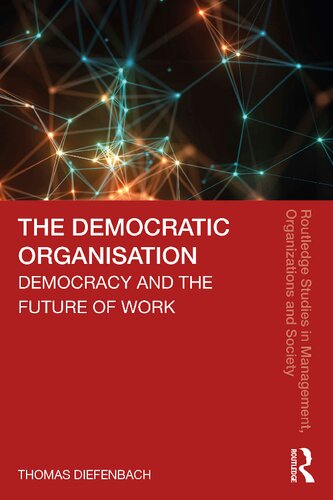
The Democratic Organisation Democracy and the Future of Work 1st Edition by Thomas Diefenbach 0367362198 9780367362195


Original price was: $50.00.$35.00Current price is: $35.00.
The Democratic Organisation Democracy and the Future of Work 1st Edition by Thomas Diefenbach – Ebook PDF Instant Download/Delivery: 0367362198, 9780367362195
Full download The Democratic Organisation Democracy and the Future of Work 1st Edition after payment
Product details:
ISBN 10: 0367362198
ISBN 13: 9780367362195
Author: Thomas Diefenbach
Prevailing models of organisation divide people into owners, managers and employees, forcing especially the latter to obey, to behave, and to function well within a hierarchical and managerial pecking order. However, there is no natural law suggesting the need for such organisations, not in market economies and definitely not in modern democratic societies – and there is no justification for such types of organisation. Arguing that most current organisations are orthodox, hierarchical, anti-democratic, oppressive, unfair, and unjust, this book presents a viable alternative, a better type of organisation – the democratic organisation. Diefenbach develops and provides step by step a systematic, comprehensive, thorough, and detailed general model of the democratic organisation. He describes the democratic organisation’s fundamental principles, values, governance, management, structures, and processes, and the ways it functions and operates both within the organisation and towards others and the environment. Crucially, and most importantly, the democratic organisation provides the institutions and organisational context for individuals to maintain and pursue their fundamental freedoms, inalienable rights, and dignity; to manage organisations in democratic, participative, and cooperative ways; and to conduct business in considerate, balanced, and sustainable ways. This book will be of interest to researchers, academics, practitioners, and students in the fields of management, organisation studies, strategic management, business ethics, entrepreneurship, and family business.
The Democratic Organisation Democracy and the Future of Work 1st Table of contents:
1. Prevailing Organisations and Alternatives
What’s Wrong with Our Organisations?
Viable Alternatives: Democratic Organisations
Interest-Oriented Democratic Organisations
Ownership-Oriented Democratic Organisations
Social and Solidarity Economy (SSE) Organisations
Key Criteria of Democratic Organisations
PART I: The Model of the Democratic Organisation
2. Libertarian Constitution
Free Will and Free Individuals
Self-Ownership and Inalienable Rights
Private Ownership and Property Rights
The Partnership Agreement and the Democratic Organisation
3. Democratic Governance
Governance: Democratic Governance
Democratic Institutions of Governance
Legitimate Authoritative Sources
Democratic Governing
‘Good Governance’
Democratic Governance of the Democratic Organisation
4. Democratic Management
Hierarchy and/or Heterarchy: Democratic Management
Self-Management
Representative Management
Participative Management
The Elements of Democratic Management
5. Equalising Empowerment
From Equal Rights to Equal Power and the Idea of Equalising Empowerment
Meaning(s) and a Three-Dimensional Concept of Empowerment and Disempowerment
The Formal, Psychological, and Social Disempowerment of the Many
Empowering the Disempowered Many
The Formal, Psychological, and Social Empowerment of the Few
Disempowering the Empowered Few
How Equalising Empowerment Works
6. Considerate Conduct of Business
Conduct of Business: Considerate Conduct of Business
People: Social Orientation and Social Behaviour
Planet: Pro-environmental Behaviour
Profit: Economic and Other Performance
7. General Model of the Democratic Organisation
The General Model of the Democratic Organisation
Democratic Organisations Are Better, Do Better, and Perform Better
PART II: Attractiveness, Legitimacy, and Vulnerabilities of Democratic Organisations
8. The Case for Democratic Organisations
(Alleged) Disadvantages and Weaknesses of Democratic Organisations
Why People Start or Join Democratic Organisations
Strengths and Advantages of the Democratic Organisation
9. Legitimate and Illegitimate Organisations
Freedom of Contract and the Legitimacy of Organisations
The Legitimacy of Various Types of Organisations
Different Types of Organisation – and What to Do about Them
10. The Iron Threat(s) of Disproportional Empowerment
The Phenomenon of Disproportional Empowerment
Social Processes and Dynamics Detrimental to the Democratic Organisation
A Sequence of Disproportional Empowerment
Consequentialist and Non-consequentialist Arguments against Disproportional Empowerment
People’s Part in the Emergence of Disproportional Empowerment
People Who Consciously Strive for Power and Empowerment: ‘Anti-social Perpetrators’
People Who Cause Disproportional Empowerment Accidentally: ‘Unreflective Doers’
People Who Let Disproportional Empowerment Happen: ‘The Disengaged’
Preventing the Threat(s) of Disproportional Empowerment
People also search for The Democratic Organisation Democracy and the Future of Work 1st:
what is workplace democracy
democratic organizations examples
future of work trends
employee participation in organizations
organizational democracy explained
Tags: The Democratic, Organisation, Democracy, Future of Work, Thomas Diefenbach