

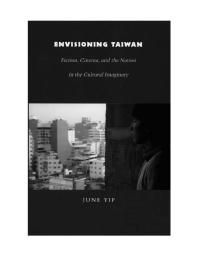
Envisioning Taiwan Fiction Cinema and the Nation in the Cultural Imaginary 1st Edition by June Yip, Rey Chow, Harry Harootunian, Masao Miyoshi ISBN 0822386399 9780822386391
Original price was: $50.00.$35.00Current price is: $35.00.
Envisioning Taiwan Fiction Cinema and the Nation in the Cultural Imaginary 1st Edition by June Yip, Rey Chow, Harry Harootunian, Masao Miyoshi – Ebook PDF Instant Download/Delivery: 0822386399, 9780822386391
Full download Envisioning Taiwan Fiction Cinema and the Nation in the Cultural Imaginary 1st Edition after payment
Product details:
ISBN 10: 0822386399
ISBN 13: 9780822386391
Author: June Yip, Rey Chow, Harry Harootunian, Masao Miyoshi
Envisioning Taiwan Fiction Cinema and the Nation in the Cultural Imaginary 1st Table of contents:
1: Confronting the Other, Defining a Self: Hsiang-t’u Literature and the Emergence of a Taiwanese Nationalism
Encountering the Other: Taiwan’s Colonial History
Hsiang-t’u Literature and Taiwanese Nationalism
Postwar Modernization and Neocolonialism
Political Crisis in the 1970s and the Call for Nationalism
The Impact of Western Modernism on Taiwanese Literature, 1950-71
Back to the Earth: The Rise of Hsiang-t’u
The Hsiang-t’u Literary Debates of 1977-78
Nationalism or Separatism? The Modernist Response
Hwang Chun-ming and the Hsiang-t’u Debates
The Ascendency of Taiwanese Consciousness: Political Liberalization and the Rise of Neonativist “Taiwan Literature”
2: Toward the Postmodern: Taiwanese New Cinema and Alternative Visions of Nation
Cinema and the National
What is Taiwanese New Cinema?
A Sense of Place: Taiwanese New Cinema and the Hsiang-t’u Heritage
The Ideological Phase: Taiwanese New Cinema and Third Cinema
3: Remembering and Forgetting, Part I: History, Memory, and the Autobiographical Impulse
Popular Memory and the History of the Everyday
Cinema and History: The Politics of Representation
History, Autobiography, and Cultural Crisis A Time to Live and a Time to Die
Writing the Self into History
4: Remembering and Forgetting, Part II: Hou Hsiao-hsien’s Taiwan Trilogy
Interweaving Past and Present: Critical Historiography or the Uses of the Past
Taiwan after Martial Law: Hou Hsiao-hsien’s Taiwan Trilogy
Decolonization and the Recuperation of History: City of Sadness
Interweaving Public and Private: Narrative and the Open Texture of History
The Transition to Nationalist Rule: 1945-49
The February Incident and the March Massacres
A Look Back to the Future
Play/Dream/Life: The Puppetmaster and the Theater of History
History and Memory
Deconstructing the Past: The Illusion of History, the Inscrutability of the Self
Memory and Imagination: Good Men, Good Women and the White Terror
5: Language and Nationhood: Culture as Social Contestation
Decolonizing the Word: Language, Culture, and the Building of Nations
The Colonized Writer’s Dilemma: Linguistic “Abrogation” and “Appropriation”
Language and Power: Taiwanese Encounters Mandarin
Oral Culture and Native Wisdom: The Storyteller
Oral Culture and Carnivalesque Subversion: “The Gong”
Speaking in Tongues: Bilingualism, Translation, and Postcoloniality
Toward Heteroglossia: Taiwanese New Cinema and the Language Issue
Third Cinema and the Search for an Alternative Visual Language
Italian Neorealism and Third Cinema
Chinese Aesthetics and Taiwanese New Cinema
Spectatorship and the Potential for Change
6: The Country and the City: Modernization and Changing Apprehensions of Space and Time
Sociopolitical Development and the Rural/Urban Model
Modernization, the Rural Idyll, and Taiwanese Hsiang-t’u Literature
The Rural World and the Maternal Sphere
From Rural Organicity to Urban Fragmentation: The Spatio-Temporal Structures of the Country and the City
New German Cinema and the Anti-Heimatfilme/Taiwanese New Cinema’s Revised Vision of Hsiang-t’u
The Rural Past: Summer at Grandpa’s
The Urban Future: The Boys from Feng Kuei
The Undefined Present: Dust in the Wind
7: Exile, Displacement, and Shifting Identities: Globalization and the Frontiers of Cultural Hybridity
Multinational Capitalism, Global Consumer Culture, and Taiwan since the 1980s
Exile and Displacement: The Multicultural Metropolis and Alternative Models of Identity Formation
“Exile” and the Poetics of Nostalgia
Toward Postmodernism: The “Global Teenager” and Hou Hsiao-hsien’s Daughter of the Nile
Displacement and the Politics of Travel: Border Crossings and Exploring the Space in Between
Hybridity, Multiplicity, Difference: “I Am a Crowd”
Conclusion: From Nation to Dissemi-Nation: Postmodern Hybridization and Changing Conditions for the Representation of Identity
Transnationalism and the Transition into the New Millenium: Taiwan in the 1990s and Beyond
More Global and More Local
Postcolonial, Postmodern… Postnational?
Postnationalism and the Chinese Diaspora: Some Final Thoughts on Future Directions
Notes
Introduction
1: Confronting the Other, Defining a Self
2: Toward the Postmodern
3: Remembering and Forgetting, Part I
4: Remembering and Forgetting, Part II
5: Language and Nationhood
6: The Country and the City
7: Exile, Displacement, and Shifting Identities
Conclusion
Bibliography
Chinese Sources
Western-Language Sources
Films by Hou Hsiao-hsien
People also search for Envisioning Taiwan Fiction Cinema and the Nation in the Cultural Imaginary 1st:
taiwan fiction
taiwan cinematic
cinema of taiwan
taiwan travel cinematic
la croisette cinema movies
Tags: June Yip, Rey Chow, Harry Harootunian, Masao Miyoshi, Taiwan Fiction, Nation, Cultural Imaginary